
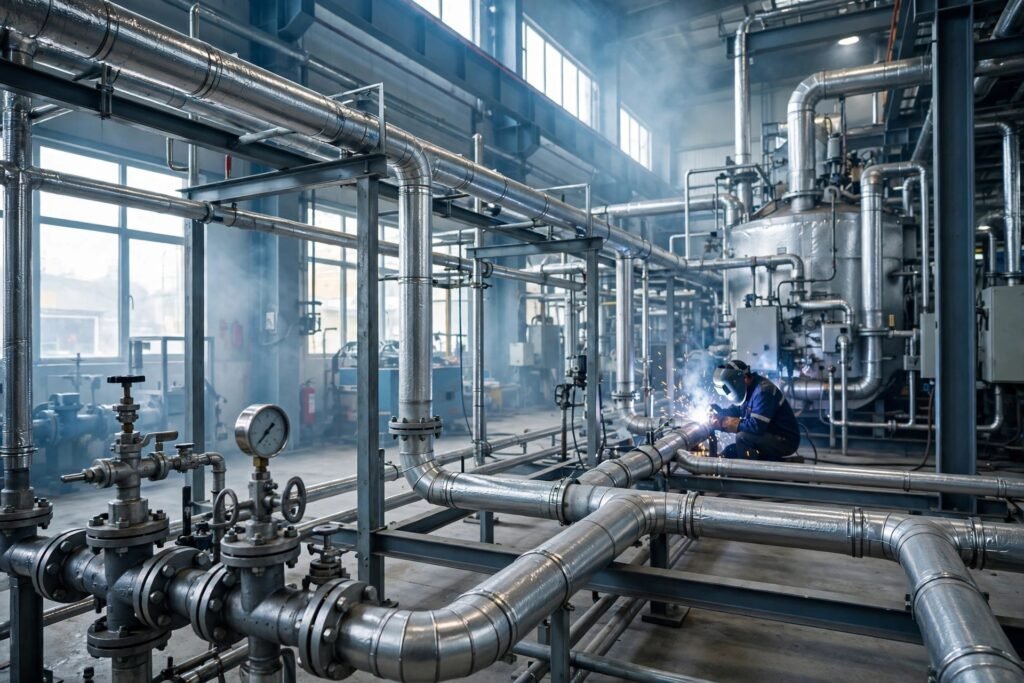
If your factory in Bengaluru, Hosur Road, Peenya, Bidadi or anywhere else in Karnataka runs a boiler, the steam lines leaving it are regulated too. Plant teams usually call this “IBR piping”, after the Indian Boiler Regulations. Since 2025, the law behind IBR steam pipeline approval has been rewritten:
- The Boilers Act, 2025 came into force on 1 May 2025. It replaced the Boilers Act, 1923.
- The Indian Boiler Regulations, 2026 (IBR 2026) were published in the Gazette of India on 1 October 2026. They took effect on publication and replace the Indian Boiler Regulations, 1950.
This guide explains, in plain language, when a steam line falls under the law, what the new regulations say about plans, materials, welders and hydraulic tests, and what to check before you add, extend or change a steam pipeline. It is a practical overview, not legal advice. Your Inspector of Boilers has the final word.
Step 1: Check whether your line counts as a “steam-pipe”
Under Section 2(r) of the Boilers Act, 2025, a steam-pipe is any pipe through which steam passes if:
- the steam pressure exceeds 3.5 kg/cm² (about 3.4 bar) above atmospheric pressure, or
- the pipe’s internal diameter exceeds 254 mm and the steam pressure exceeds 1 kg/cm² above atmospheric pressure.
In both cases the definition includes any connected fitting of a steam-pipe and feed-pipe. Feed water lines that run directly to the boiler (Section 2(i)) and other “boiler components” under pressure above 1 kg/cm² gauge (Section 2(d)) are covered as well.
What this means on the plant floor: most process steam headers, distribution lines and pressure-reducing stations in factories run above 3.5 kg/cm² (about 3.4 bar), so they usually come under the Act. A low-pressure line below both thresholds is outside this definition, but it still needs sound engineering, testing and safe operation. If you are unsure, ask the Inspector before you design, not after you weld.
Step 2: Know what changed in 2025–2026, and what is still settling
Verified from official sources:
- The Boilers Act, 2025 (Act 12 of 2025) was enacted on 4 April 2025. It came into force on 1 May 2025 by notification S.O. 1943(E).
- IBR 2026 was made by the Central Boilers Board under Section 40 of the Act. It was notified on 7 August 2026 and published in the Gazette on 1 October 2026. It supersedes IBR 1950, “except as respects things done or omitted to be done before such supersession”.
Still worth checking with the Karnataka department:
- Which state-level rules, forms and fees now apply in Karnataka under the 2025 Act. Older Karnataka documents still refer to the 1923 Act and IBR 1950.
- How applications already in progress before 1 October 2026 are being handled.
In Karnataka, boiler and steam pipeline matters sit with the Department of Factories, Boilers, Industrial Safety & Health. Invest Karnataka’s single-window list of live services (April 2026) includes “Registration of steam pipeline” and “Registration of Boilers, Economizers and Steam Pipelines”.
Step 3: The IBR Steam Pipeline Approval Process, Step by Step
IBR 2026 (regulations 322 and 323) and the Act set out this sequence:
- Plans before construction. Submit plans of the steam pipes, including mountings and fittings, with the prescribed fee to the Inspecting Authority before construction. They also go to the Chief Inspector when the boiler is registered, who decides whether the pipes and their layout comply (reg. 323(1)).
- Scrutiny fee. As printed in the Gazette, Table 8/11 sets plan scrutiny for steam pipes at ₹200 per 30 metres of piping or part thereof (minimum ₹500), plus separate per-category fees for fittings. Confirm the current amount on the department’s portal before you pay.
- Approved materials. Steam pipes may be carbon steel, cast steel, alloy steel or nickel alloys. They may be solid drawn, butt welded or electric resistance welded (reg. 249). Keep material test certificates for every pipe and fitting.
- Certified welders only. No welder or welding operator may weld boilers or steam-pipes during construction, erection, site fabrication or repair without the certificate the regulations require (reg. 513; Sections 7 and 10 of the Act).
- Hydraulic test before use. Pipes must be inspected and hydraulically tested before use in place, at the test pressure set for steam pipes (reg. 322(1)). The Chief Inspector then tells the owner the pressure and temperature at which the line may be used.
- Inspection record. The Inspector opens a Memorandum of Inspection Book (Form XIV) for the pipeline. It records dimensions, calculations, hydraulic test details and inspection notes (reg. 322(3)).
Step 4: Treat extensions and modifications as regulated work
Plants often extend a header to a new machine, re-route a line during a layout change, or replace a corroded section. Under Section 18 of the Boilers Act, 2025:
- The owner of a registered boiler who intends to make a structural alteration, addition or renewal to a steam-pipe must first report it in writing to the Chief Inspector, with the particulars the regulations specify.
- The work must be done by a person holding a boiler repairer certificate, under the supervision of a competent person.
IBR 2026 adds that a pipeline’s approved pressure and temperature cannot be changed without the Chief Inspector’s written authority (reg. 322(3)(e)). During later inspections, the competent person can ask for lagging to be removed at flanges. If the pipes look unsatisfactory, the Chief Inspector can order a hydraulic test at not less than 1.5 times the boiler’s design pressure or the pipe’s maximum allowable working pressure (reg. 322(2)).
The practical rule is simple: do not hot-tap, extend or re-route a regulated steam line as routine maintenance. Plan it as a regulated change.
Step 5: Get the engineering right, not just the paperwork
Approval confirms compliance. A steam system still has to work well and safely day to day. When you review a design or a contractor’s proposal, check the industrial piping engineering for:
- Line sizing that keeps steam velocity and pressure drop reasonable for the load, and leaves room for future expansion.
- Drainage: lines sloped in the direction of flow, drip legs and steam traps at low points and before control valves, to reduce water hammer risk.
- Thermal expansion: loops or expansion joints, with properly designed anchors, guides and supports.
- Pressure-reducing stations with isolation, strainers, bypass arrangements and correctly set relief protection downstream where required.
- Insulation and cladding that protects people and cuts heat loss, with removable sections at flanges for inspection.
- Condensate return, so recoverable condensate goes back to the feed system instead of to drain.
- As-built drawings updated after site changes, since the approved drawings and the pipeline on site should match.
For the safety side of steam systems, see our earlier article on preventing steam piping accidents. For weld quality, see visual inspection best practices in pipe fabrication and pipe fabrication for high-pressure systems.
Step 6: Documents for Steam Pipeline Registration in Karnataka
- Approved steam line drawings (and revised drawings for any site deviations)
- Fee payment receipts for plan scrutiny and registration
- Material test certificates for pipes, fittings, flanges and valves
- Welders’ certificates for every welder who worked on the line
- Weld and NDT records where the Inspector asks for them
- Hydraulic test record, with the Inspector’s acceptance
- The boiler’s registration certificate and the pipeline’s Memorandum of Inspection Book
A tidy handover file also helps at commissioning. Our MEP testing, commissioning and handover checklist covers the wider handover.
Questions to ask a steam piping contractor
- Do you, or your erection partner, hold the boiler repairer or erector certification Karnataka requires for this work? Can we see it?
- Are your welders’ certificates current, and valid for this material and process?
- Who prepares the drawings and calculations for submission, and who coordinates with the Inspecting Authority and the Inspector of Boilers?
- What is your hydraulic test procedure, and who witnesses it?
- How will you handle drainage, expansion, supports, insulation and condensate return?
- Will you give us as-built drawings and a complete document file at handover?
Frequently asked questions
Not necessarily. The Boilers Act, 2025 covers steam pipes above 3.5 kg/cm² (about 3.4 bar, above atmospheric), or above 254 mm internal diameter and 1 kg/cm², plus connected fittings of steam-pipes and feed-pipes. Lines below both thresholds fall outside that definition. Confirm borderline cases with the Inspector of Boilers.
IBR 1950 has been superseded by the Indian Boiler Regulations, 2026, published on 1 October 2026, except for things already done or omitted before then. Ask the department how in-progress applications are being handled.
Yes. The Act defines feed-pipes separately and includes connected fittings of steam-pipes and feed-pipes in the steam-pipe definition. Feed piping is also listed as a boiler component.
Only if they hold the welder's certificate the regulations require for that material and process. Welding on a regulated steam-pipe without that certificate is not permitted, even as a routine repair.
We do not publish a timeline. It depends on the completeness of drawings and documents, the inspection schedule and the department's current process. Build inspection and test stages into your project plan, and check the current position with the department.
New pipes are tested before use at the pressure the regulations set for steam pipes. If the Chief Inspector orders a test after inspection, it must be at least 1.5 times the boiler's design pressure or the pipe's maximum allowable working pressure, as applicable.
Planning a steam line? Talk to SRJ Group
Since 1985, SRJ Group has delivered industrial piping work for factories in Karnataka, and we can take on IBR steam pipeline work for your plant. If you’re planning a new steam line or an extension, contact our team to discuss it.
Sources
- India Code, The Boilers Act, 2025 (Act 12 of 2025): https://www.indiacode.nic.in/handle/123456789/21395 (section text read via the EasyActs bare-act mirror, https://easyacts.in/acts/the-boilers-act-2025, Sections 2, 7, 9, 10, 11 and 18; accessed 12 Nov 2026)
- Gazette of India, S.O. 1943(E), 30 April 2025, commencement of the Boilers Act, 2025 (summary and full text: https://gazettetracker.com/g/CG-DL-E-01052025-262788)
- Gazette of India Extraordinary, Part III Section 4, No. 596, 1 October 2026 (e-Gazette CG-DL-E-06102026-276813): Indian Boiler Regulations, 2026, https://egazette.gov.in/WriteReadData/2026/276813.pdf (official Gazette PDF, verified 12 Nov 2026; a copy is also hosted by the Government of Chhattisgarh: https://invest.cg.gov.in/boiler-knowledge-management/download/Indian%20Boiler%20Regulations,%202026.pdf), regulations 249, 322, 323, 513 and Table 8/11
- Invest Karnataka, “Services which are live in SWS portal” (April 2026): https://investkarnataka.co.in/wp-content/uploads/2026/04/Services-which-are-live-in-SWS-portal.pdf
- Department of Factories, Boilers, Industrial Safety & Health, Karnataka: https://esuraksha.karnataka.gov.in/en