
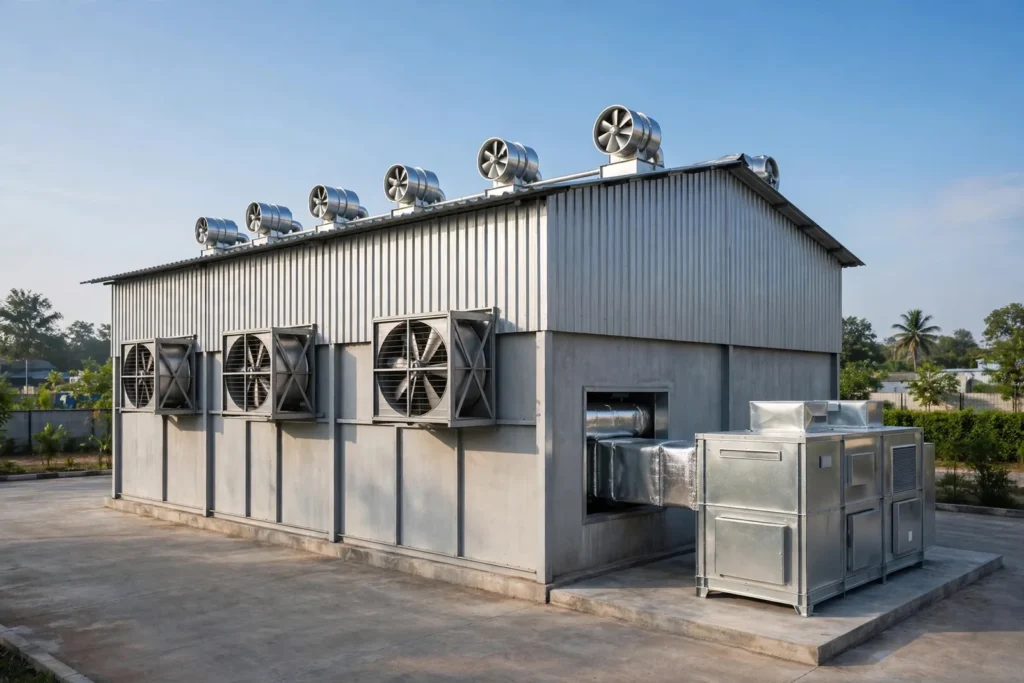
On an April afternoon in many Bengaluru factory sheds, hot air sits under the metal roof and the welding bay is hazy. Industrial ventilation is often an afterthought: a few wall fans, some turbo ventilators and an air washer if the budget allows. Picking equipment that way rarely works well.
This guide is for factory owners, plant heads and project teams in Bengaluru and across Karnataka. It explains what the rules ask for, how to work out the airflow you need, and how to choose between exhaust fans, turbo ventilators, supply fans and air washers.
Note: This article is general guidance, not a design. Your process, your building and the Department of Factories, Boilers, Industrial Safety and Health have the final word on what your factory needs.
What the rules say about industrial ventilation in factories
The OSH Code, 2020 and the Central Rules, 2026
The Occupational Safety, Health and Working Conditions Code, 2020 (OSH Code) came into force on 21 November 2025 (Ministry of Labour and Employment notification S.O. 5321(E)). The Code repeals the Factories Act, 1948.
Section 23 of the Code makes the employer responsible for the health, safety and working conditions prescribed by the Central Government, and lists “ventilation, temperature and humidity” and an “environment free from dust, noxious gas, fumes and other impurities” among them. The OSH (Central) Rules, 2026, notified on 8 May 2026 (G.S.R. 345(E)), set these out for factories:
- Rule 23 (ventilation, temperature and humidity): the employer of every factory must keep suitable atmospheric conditions, by natural or artificial means. That means avoiding stagnant or vitiated air, harmful draughts and excessive heat. There must be adequate ventilation to clear away smoke, fume, steam and dust. Mechanical ventilation must be provided where natural ventilation cannot supply enough fresh air without uncomfortable draughts. Workers must be protected from heat radiated by hot equipment, steam pipes and hot surfaces.
- Rule 24 (dust, gas and fumes): exhaust systems for flammable fumes, gases, mists or vapours must not be connected to any other ventilating system, or discharged into a chimney or flue carrying combustion gases. Where the exhaust is likely to harm employees or neighbours, it must pass through a system that neutralises it.
These rules state outcomes, not a number of air changes.
Karnataka: the 15 percent and ten air change rules
Karnataka’s own rules under the OSH Code were still at draft stage when this was written. The Labour Department republished the draft Occupational Safety, Health and Working Conditions (Karnataka) Rules, 2026 on 23 January 2026. Section 143(3) of the Code keeps rules made under the repealed Acts in force until they are repealed, as long as they do not contradict the Code. That is why the Karnataka Factories Rules, 1969 are still worth knowing. They contain the most specific numbers a Karnataka factory is likely to meet:
- Rule 21(1): if no mechanical general ventilation is used, the ventilating openings in every room where workers are ordinarily employed must be at least 15 percent of the floor area.
- Rule 21(2): if ventilation is by mechanical power, the fans must be able to pass through the room, ten times every hour, a volume of air equal to the room’s cubic capacity. In other words, 10 air changes per hour.
- Rule 21(3): where nothing is built above the room, the roof must be high enough to reduce radiant heat, or have an insulated false ceiling with an air gap that vents at the eaves or the apex.
- Rule 20 (cooling): the Chief Inspector can order fans, more roof height, an insulating roof layer, or sunshades where workers are exposed to heat.
Check with the Department of Factories, Boilers, Industrial Safety and Health which rules it currently applies to your factory, especially once final Karnataka rules are notified.
What the National Building Code recommends
The National Building Code of India 2016 (NBC 2016), Part 8 Section 1, gives recommended air change rates. It notes that the Factories Act itself set no air change figure. BIS has since published the National Building Construction Standards 2026 (NBCS 2026, SP 7:2026), which replaces the NBC 2016. The values below are from NBC 2016, so check them against NBCS 2026 Part D before you finalise a design.
| Space (NBC 2016 Part 8 Sec 1, cl. 5.2.2.1) | Recommended air changes per hour |
|---|---|
| Factories and workshops | 8 to 10 |
| Stores and warehouses | 3 to 6 |
| Foundries | 15 to 30 |
| Paint shops (not cellulose) | 10 to 20 |
| Electroplating shops | 10 to 12 |
| Compressor rooms | 10 to 12 |
| Canteens | 8 to 12 |
| Lavatories | 6 to 15 |
These rates assume no combustion products or other contaminants. The NBC is voluntary unless an authority or your contract adopts it.
Step 1: Work out how much air you actually need
Work out how much air industrial ventilation must move before you choose fans or vents.
- Measure the volume. Floor area multiplied by average height (take the average of eaves and ridge heights for a pitched roof).
- Pick the air change rate. Use 10 air changes per hour as the Karnataka Factories Rules baseline for mechanically ventilated workrooms, then check it against the NBC range for your type of space.
- Check the heat load. NBC 2016 Part 8 Section 3 (cl. 11.2.2) says ventilation for heat control should be calculated from the sensible and latent heat load. That includes solar gain through the roof, people, lighting, machines and process heat. Use whichever airflow is larger.
- Add local exhaust for welding, grinding, painting, chemical or dust sources (see below). General ventilation alone does not clean the air at a welder’s face.
A worked example (illustrative only): a shed 60 m long, 30 m wide and 8 m average height has a volume of 14,400 m³. At 10 air changes per hour, the fans need to move 144,000 m³ of air per hour. If the same shed relied on natural ventilation only, rule 21(1) would call for at least 270 m² of ventilating openings (15 percent of 1,800 m²).
Two practical points:
- Fans are rated at a pressure. A fan delivers less air once it pushes through louvres, insect screens, filters or ducts. Ask for the airflow at the expected installed pressure, not “free air” figures.
- Make-up air matters as much as exhaust. NBC 2016 Part 8 Section 3 (cl. 11.2.1.1) says an extract system needs a planned inlet for make-up air, and the inlet should not be next to the exhaust fan. Fans pulling against closed shutters simply move less air.
Exhaust fans, turbo ventilators or air washers?
NBC 2016 describes three basic mechanical strategies: mechanical extract with natural supply, mechanical supply with natural extract, and mechanical supply with mechanical extract. Most industrial ventilation equipment fits into one of them.
| Option | How it works | Works well for | Watch out for |
|---|---|---|---|
| Wall or roof exhaust fans (propeller or axial) | Pull hot or stale air out; fresh air enters through openings | General ventilation of sheds; meeting a set air change rate | Creates negative pressure and draws in outside dust; needs planned inlets; noise |
| Supply fans with filters | Push filtered outdoor air in; air leaves through openings | Dusty surroundings; areas that must stay clean | Need filters and maintenance; exhaust path must be planned |
| Turbo (wind-driven) roof ventilators, ridge vents | Use wind and rising hot air; no motor | Helping hot air escape at roof level | Airflow varies with wind and temperature difference; cannot guarantee a fixed air change rate |
| Air washer or evaporative cooling unit | Fan pushes outdoor air through water-wetted media, cooling and humidifying it | Lowering supply air temperature in hot, drier months | Adds moisture; less effective in humid weather; needs water treatment and cleaning |
| Mechanical supply plus mechanical extract | Separate supply and exhaust fan systems | Best control of air quality and pressure | Higher cost and complexity |
Exhaust fans
Exhaust fans are the simplest way to achieve a predictable air change rate. Place them high, near heat sources, with inlets low on the opposite side so fresh air sweeps the working zone. NBC 2016 warns that extract-only systems create negative pressure, so they suit neither dusty surroundings nor clean interiors.
Turbo ventilators and ridge vents
Turbo ventilators need no power, which makes them popular. But their output depends on wind speed and the inside-outside temperature difference, so on a still afternoon they may move very little air. NBC 2016 Part 8 Section 1 supports high-level outlets for stack effect: openings close to the roof and ridge vents let hot air escape. If you use turbo ventilators, treat them as a supplement. Ask the supplier which wind speed and temperature their airflow figure assumes, and get the roof flashing detailed properly so the monsoon does not find the gaps. Our guide to industrial shed construction in Bangalore covers roof insulation and vents at the building stage.
Air washers for factories: does evaporative cooling work in Bengaluru?
Air washer units cool air by evaporating water into it, which also raises its humidity. NBC 2016 Part 8 Section 3 (cl. 7.2.15) notes that evaporative cooling is most useful where ambient temperatures are moderate and wet-bulb temperatures are low. For the monsoon, it says only indirect cooling can be used, so that moisture is not added to already moist air. For Bengaluru that means:
- An air washer can make a real difference in the hotter, drier months before the monsoon.
- In humid months a direct air washer cools far less, and it can make the air feel muggy.
- Check whether your products or processes are sensitive to humidity (electronics, paper, some coatings, stored steel) before you add moisture.
- Plan for water: treatment or bleed-off to limit scale on the media, regular cleaning, and drainage. NBC 2016 lists dirty water in evaporative cooling plants as a source of indoor air quality problems.
When ventilation alone is not enough: heat stress
NBC 2016 Part 8 Section 1 (cl. 5.2.3.2 and Table 11) refers to studies by the Chief Adviser Factories. For workers in light clothing doing work of moderate severity, the wet-bulb temperature should not exceed 29°C, with a minimum air movement of 30 m/min. As the dry-bulb temperature rises, the permitted wet-bulb temperature falls: 28.5°C at 35°C dry bulb and 28.0°C at 40°C. The table notes recommend refrigeration or another cooling method where conditions would be worse.
Near furnaces, ovens and hot process lines, combine ventilation with insulating or shielding hot surfaces, spot cooling at fixed workstations, and roof insulation to cut solar gain.
Local exhaust for fumes, dust and paint
General ventilation dilutes contaminants; local exhaust captures them at source with a hood or extraction arm. Use it for welding fumes, grinding dust, paint spraying and chemical handling.
- Flammable fume exhaust must stay separate from other ventilation systems and must not discharge into a combustion flue (OSH Central Rules, rule 24).
- Where exhaust could harm people inside or outside the plant, it needs treatment before discharge (rule 24). This can also bring your Karnataka State Pollution Control Board consent into play, so check your consent conditions.
- For fans handling dust-laden or contaminated air, NBC 2016 Part 8 Section 3 (cl. 11.7.2) says the motor, pulleys, bearings and belts should be kept out of the air stream.
Fire safety: where ventilation meets fire protection
Ventilation ducts can spread smoke and fire if they are not detailed correctly. NBCS 2026 Part F (Fire and Life Safety), clause 3.5.7, says:
- Where ducts pass through fire walls or floors, the gap around them must be sealed to the compartment’s fire rating, and fire dampers fitted unless the duct is part of the fire safety system.
- AHU filters must be non-combustible, and AHU rooms must not be used to store combustible material.
- Duct insulation must be non-combustible, with inspection panels for cleaning and damper access.
NBC 2016 Part 8 Section 3 (cl. 12.4.1.10) adds that smoke dampers should be provided in supply and return ducts where they cross the walls of fan rooms, AHU rooms and air washer rooms. Make sure the ventilation contractor, the fire alarm contractor and your fire consultant agree which fans stop, and which keep running, when the fire alarm activates. Our fire safety audit checklist covers how auditors look at these interfaces.
Buyer checklist before you ask for quotations
| # | Question | Why it matters |
|---|---|---|
| 1 | What is the shed volume, and what air change rate is the design based on? | Ten air changes per hour is the Karnataka rule 21(2) baseline for mechanically ventilated workrooms |
| 2 | Has the heat load (roof, machines, process, people) been calculated? | Hot processes may need more air than the air change rate gives |
| 3 | Where do the inlets and outlets go, and is make-up air planned? | Fans without inlets underperform |
| 4 | Is each fan’s airflow quoted at the installed pressure? | “Free air” ratings overstate delivered airflow |
| 5 | Which sources need local exhaust (welding, painting, dust, chemicals)? | General ventilation does not capture fumes at source |
| 6 | Will an air washer add moisture your product or process cannot tolerate? | Evaporative cooling raises humidity |
| 7 | How will the air washer’s water be treated, drained and cleaned? | Scale and dirty water reduce performance and air quality |
| 8 | Are fire dampers, smoke dampers and fire alarm interlocks shown on the drawings? | NBCS 2026 Part F and NBC requirements apply to ducts and plant rooms |
| 9 | What are the electrical load, cabling, starters and controls for the fans? | Ventilation adds connected load to your power distribution |
| 10 | How will airflow be tested and recorded at handover? | Measured results prove the design works |
For testing and handover records, see our MEP testing, commissioning and handover checklist. If ventilation is part of a larger fit-out, our MEP scope of work checklist helps you write it into one coordinated package.
Frequently asked questions
Rule 21(2) of the Karnataka Factories Rules, 1969 requires mechanical ventilation to move a volume of air equal to the room’s cubic capacity ten times every hour. That is 10 air changes per hour. NBC 2016 recommends 8 to 10 for factories and workshops. Processes with heat, fumes or dust may need more.
It can be, if openings are large and well placed. Rule 21(1) asks for openings of at least 15 percent of the floor area where there is no mechanical general ventilation. NBC 2016 notes that wind alone cannot be relied on to ventilate factory buildings wider than about 30 m, and that roof ventilation can be added for wider buildings.
Not on their own. Their airflow depends on wind and temperature difference, so they cannot guarantee a fixed air change rate. Treat them as a supplement to a calculated system.
It works best in the hotter, drier months, when the wet-bulb temperature is low. In humid monsoon weather a direct air washer gives much less cooling and adds moisture. NBC 2016 notes that only indirect evaporative cooling can be used in the monsoon.
No. The OSH Code, 2020 came into force on 21 November 2025 and repealed it. Rules made under the old Act continue, under the Code’s savings clause, to the extent they are not contrary to the Code, until they are repealed. Karnataka’s rules under the Code were still a draft at the time of writing.
NBC 2016 recommends 3 to 6 air changes per hour for stores and warehouses, lower than for workshops. If people work in the warehouse, or there are battery charging, packing or dusty operations, check the requirements for those areas separately.
Where ducts pass through fire walls or floors, NBCS 2026 Part F calls for fire dampers and sealing to the compartment’s fire rating, unless the duct is part of the fire safety system itself.
Planning industrial ventilation for a factory in Karnataka?
Since 1985, SRJ Group has delivered industrial projects. Our MEP systems team covers HVAC and ventilation, including air handling units and ductwork, together with power distribution, fire alarm and ELV, and plumbing. If you are planning or upgrading industrial ventilation for a factory or warehouse in Bengaluru or elsewhere in Karnataka, see our MEP systems page or contact us with your building drawings and process details. We can then discuss a suitable ventilation arrangement.
Sources
- Ministry of Labour and Employment, Notification S.O. 5321(E), 21 November 2025 (OSH Code, 2020 commencement): https://www.labour.gov.in/static/uploads/2025/12/68ed1ca2d97e2849c07e9972370577b6.pdf
- Occupational Safety, Health and Working Conditions Code, 2020, India Code record: https://www.indiacode.nic.in/handle/123456789/22041?locale=en (Section 23 text read via https://www.lawmaker.in/bare-acts/occupational-safety-health-and-working-conditions-code-2020/section-23)
- Occupational Safety, Health and Working Conditions (Central) Rules, 2026, G.S.R. 345(E), 8 May 2026, rules 23 and 24 (Gazette copy hosted by PRS): https://prsindia.org/files/bills_acts/bills_parliament/2026/Occupational_Safety_Rules,%202026.pdf
- Karnataka Labour Department, Draft OSH and WC (Karnataka) Rules, 2026, 23 January 2026 (listing): https://karmikaspandana.karnataka.gov.in/16/new-labour-rules-and-bills/en
- Karnataka Factories Rules, 1969 (as amended to 2002), rules 19 to 21 (Gazette compilation hosted by WikiLabour): https://www.wikilabour.in/api/gazettes/152/pdf
- National Building Code of India 2016, Part 8 Section 1, Lighting and Natural Ventilation, cl. 5.2.2.1, 5.2.3.2 (Table 11), 5.4.2, 5.4.3: https://codevisor.in/codes/read/4c257be7-232e-488a-9e05-19dd2d8f7ff9/04-part-8-section-1-lighting-and-natural-ventilation
- National Building Code of India 2016, Part 8 Section 3, Air Conditioning, Heating and Mechanical Ventilation, cl. 7.2.15, 11.1, 11.2, 11.7, 12.4: https://codevisor.in/codes/read/4c257be7-232e-488a-9e05-19dd2d8f7ff9/06-part-8-section-3-air-conditioning-heating-and-mechanical-ven
- National Building Construction Standards 2026 (SP 7:2026), Part F Fire and Life Safety, cl. 3.5.7 (copy hosted by Goa Directorate of Fire and Emergency Services): https://dfes.goa.gov.in/wp-content/uploads/2026/05/sp7_2026_nbcs-212-1480.pdf