
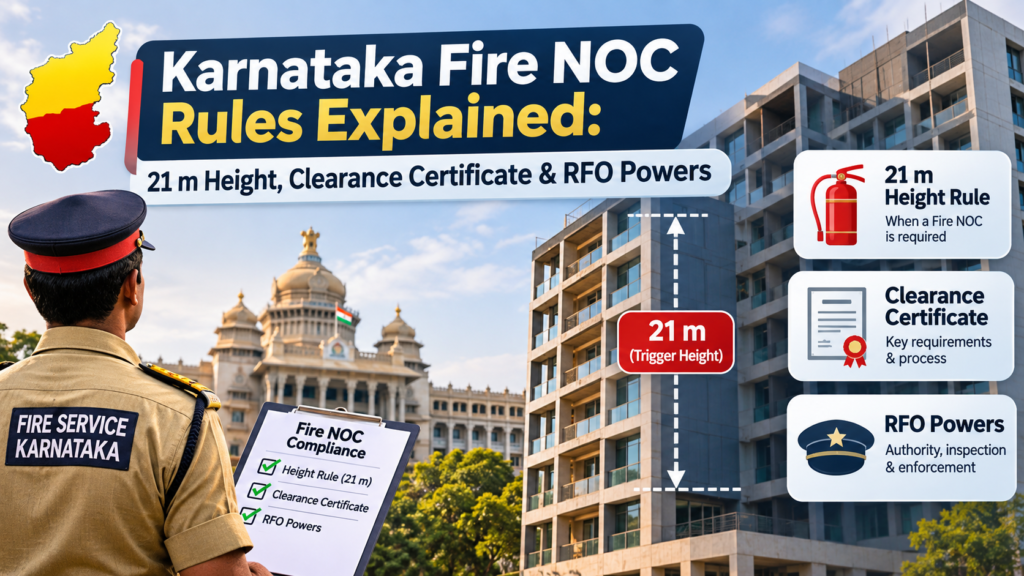
For builders, factory owners and facility managers in Karnataka, a fire No Objection Certificate (NOC) from the Karnataka State Fire and Emergency Services (KSFES) is often the gate between plan sanction, fit-out and a lawful occupancy certificate. Confusion is common: people still hear “15 metres”, while the statute that now defines a high-rise for Fire Force Act purposes uses 21 metres. This guide explains the current legal framework, the stages of approval, who can sign an NOC after recent decentralisation, and where a fire-protection contractor fits — without inventing fees, timelines or guarantees.
SRJ Group (https://srjpipingindia.com), Bangalore, has worked in fire protection, MEP, structural steel, industrial piping and water treatment since 1985. The notes below are for awareness; always verify the live checklist on the KSFES site and Seva Sindhu before you apply.
What the law requires
The parent statute is the Karnataka Fire Force Act, 1964 (Karnataka Act 42 of 1964). Section 13 originally empowered the State Government to notify fire-risk premises and order precautions. After the Carlton Towers fire and related court directions, Home Department notification HD 33 SFB 2011 (7 July 2011) strengthened preventive oversight for taller buildings and linked local bodies to fire clearances — a regime that historically spoke in terms of buildings of about 15 m and above.
In 2023 the Legislature inserted an express high-rise NOC duty. The Karnataka Fire Force (Amendment) Ordinance, 2023 (promulgated 24 March 2023) was replaced by the Karnataka Fire Force (Amendment) Act, 2023 (Act 24 of 2023; assent and Gazette 27 July 2023), deemed in force from 24 March 2023. New Section 13(3) says any person proposing to construct a high-rise building shall obtain an NOC from KSFES. Section 13(4) requires that NOC issuance follow National Building Code of India 2016 (NBC 2016) provisions on fire and life safety, with procedure and fees as may be prescribed. The Explanation defines a high-rise as a building of 21 metres or above in height, irrespective of occupancy, as defined in NBC 2016.
Separately, a 2025 amendment to Section 15 (fire cess / surcharge on property tax for newly constructed multi-storeyed high-rise buildings) has been published; its commencement depends on a Gazette appointment notification. That cess is distinct from the NOC fee regime under Section 13(4).
21 m vs 15 m: which buildings need a fire NOC?
Verified statutory threshold: Under Section 13(3)–(4) of the Fire Force Act as amended in 2023, the mandatory high-rise construction NOC applies to buildings of 21 metres or above, regardless of occupancy. That is the current Act definition; it is not a return to a statutory 15 m high-rise NOC threshold.
So why does 15 m still appear in practice and older guidance? Three layers often get mixed:
- Statutory high-rise NOC (Fire Force Act Section 13(3)): 21 m or above — inserted by the 2023 Amendment Act / Ordinance.
- NBC 2016 Part 4 (Fire and Life Safety) and development-control practice: fire-safety design and life-safety provisions remain relevant for many buildings that are not statutory high-rises. A draft Urban Development Department zonal-regulation amendment (UDD 13 TTP 2024 (E), 21 December 2024) proposed aligning the master-plan definition of high-rise with the 21 m Fire Force Act test, while stating that buildings of 15.0 m and above should still comply with NBC 2016 fire and life safety and Development Control Regulations. Confirm whether the final Gazette notification has been issued for your planning area.
- Older KSFES / local-body practice and 2011-era notifications: historically treated many buildings above about 15 m as needing fire department involvement for licence / occupancy. News coverage of the 2018 Agni-II portal also described online NOCs for buildings over 15 m. Treat height triggers below 21 m as something to confirm with the jurisdictional RFO and the local planning authority — do not assume the Act’s 21 m line is the only trigger your project will face.
Bottom line for developers: if the proposed height is 21 m or more, Section 13(3) makes a KSFES NOC mandatory before construction of that high-rise. If height is between 15 m and 21 m, plan for NBC-compliant fire and life safety and check whether your municipal / planning authority still insists on a fire department certificate at plan or occupancy stage.
Stages: planning NOC, clearance certificate, renewal
KSFES and state facilitation material distinguish stages. Names on portals can vary slightly; the usual project sequence is:
| Stage | Typical certificate | What it unlocks |
|---|---|---|
| Before / at plan sanction | No Objection Certificate (high-rise / building proposal) | Local body plan sanction / construction licence path |
| After systems are installed | Clearance Certificate (CC) | Occupancy certificate application with the urban local body |
| During occupation | Renewal of clearance / fire safety certificate | Continued compliance evidence for authorities and insurers |
Planning-stage NOC
Section 13(3) is framed around a person proposing to construct a high-rise. In practice, applicants submit drawings and a fire-fighting / detection scheme so KSFES can assess access for fire appliances, open spaces, exits, water storage, hydrants, detection and suppression against NBC 2016 Part 4 before construction proceeds on that basis.
Occupancy / Clearance Certificate
After installation, KSFES inspects whether the as-built systems match the approved scheme. Urban local bodies commonly expect a fire Clearance Certificate before issuing an occupancy certificate (OC). Building to the NOC conditions — not only designing them — is what the clearance stage tests.
Renewal and validity
Invest Karnataka’s department-wise compliance mapping lists “Renewal of Clearance Certificate” under KSFES with a two-year periodicity, citing Notification No. HD 33 SFB 2011 (Bangalore, 7 July 2011). Contemporary reporting (including notices to multi-storey owners who had not renewed) likewise describes a two-year clearance-renewal cycle and possible escalation, including recommendations to cut electricity supply under the 2011 framework if notices are ignored. Always read the validity printed on your own certificate and diarise renewal from that date; do not rely on a blog for the anniversary.
Regional Fire Officer (RFO) powers vs DG approval
For years, many fire NOC files moved through multiple desks up to the KSFES head office in Bengaluru. According to Times of India reporting (16 September 2025), a government order dated 10 September 2025 authorised Regional Fire Officers to issue fire safety NOCs for buildings up to 21 metres (described as roughly six floors), compressing an eight-stage file movement to three. For buildings above 21 metres, approvals still come from the Director General of Police & Director General (DGP & DG) of Fire and Emergency Services. The same report states that godowns up to 15 metres also fall under RFO purview, and that a district fire officer inspects, the RFO reviews and issues the NOC after collecting the prescribed fee.
Practical takeaway: applicants for buildings at or under the 21 m band should expect to deal primarily with the local RFO range; taller towers still escalate to DG-level approval. Confirm the exact delegation for your occupancy type and height with the jurisdictional range office, because news summaries are not a substitute for the government order text.
Online application process and documents
KSFES publishes an NOC page (https://ksfes.karnataka.gov.in/160/no-objection-certificate/en) pointing to required documents, application format, fees and an application link. State Seva Sindhu also lists Fire & Emergency services for high-rise NOC and Clearance Certificate applications (coverage confirmed in reputable regional reporting). Historically, KSFES moved applications onto the Agni-II online system (The Hindu, July 2018), with Sakala-linked service timelines discussed publicly; treat any day-count as portal-specific and check the live Seva Sindhu / KSFES service card for the current service level.
- Confirm height, occupancy and approving authority — Measure height as your planning authority / NBC definition requires. Decide whether Section 13(3) (21 m+) applies and whether RFO or DG-level approval is expected.
- Assemble drawings and ownership papers — Use the checklist on the live KSFES / Seva Sindhu service page — not a printed blog list.
- Apply online and track inspection — Submit through the official channel, pay the prescribed fee shown on the portal, and respond to observations.
- Build to the NOC, then seek Clearance Certificate — Install, test and document hydrants, pumps, detection, alarms, exits and access; then apply for clearance before OC.
- Calendar the renewal — Where a two-year clearance renewal applies under the 2011 framework, renew before expiry and keep maintenance records ready for inspection.
Documents commonly listed
Secondary round-ups of Seva Sindhu’s high-rise NOC / clearance services repeatedly list a short set of uploads. Confirm against the portal on the day you apply; typical items include:
- Covering letter
- Site plan (access, gates, turning space for fire appliances)
- Ground-floor plan
- Typical floor plan
- Elevation
- Section
- Fire-fighting and detection schematic (water source and storage)
- Built-up area statement
- Ownership / title document
Older Agni-II guidance also emphasised floor plans marking fire provisions and water tanks. Structural or electrical certificates may be asked in some cases even if not on every portal checklist — follow the inspecting officer’s requisition.
Fees: Section 13(4) says fees shall be as prescribed. Commercial websites quote per-square-metre service charges from Seva Sindhu; those figures change and are not reproduced here. Read the fee line on the official service page for your occupancy class.
Penalties, enforcement and common rejection reasons
Under Section 25 of the Fire Force Act, failure without reasonable cause to comply with requirements in a notification under Section 13(1), or a direction under Section 13(2), is punishable with a fine which may extend to five hundred rupees. That is the Act’s specific “failure to take precautions” fine — modest in absolute terms, but it sits beside stronger administrative consequences under the 2011 preventive framework and local-body powers: withholding or suspending occupancy certificates, recommendations to disconnect electricity after unrepaired lapses, and, in serious cases, prosecution pathways described in public summaries of the 2011 notification. Karnataka High Court reporting has also underscored that high-rise construction blocking required fire-access driveways is treated as a public-safety issue, not a mere technicality.
Applications and clearances are commonly delayed or refused when the proposal or as-built condition fails NBC-aligned checks. Recurring themes in inspection practice and court / news coverage include:
- Inadequate setbacks or open space for fire-appliance access and aerial operations
- Insufficient driveway width, turning radius or entry gates for fire tenders
- Fire-fighting / detection schematics that do not match occupancy hazard or NBC Part 4 expectations
- Missing or undersized fire water storage, pumps, hydrants or fire-service inlets
- Means of egress, pressurisation or refuge provisions that do not match the approved height and occupancy
- At clearance stage: systems not installed, not tested, or materially different from the NOC drawings
- Incomplete ownership, area statements or inconsistent plan sets
Fix the design and site conditions; re-submission after cosmetic changes rarely helps if access geometry or water demand is wrong.
How a fire protection contractor helps
KSFES decides NOCs and clearances; a contractor cannot “get” approval. What a competent fire-protection and MEP contractor can do is reduce the gap between drawings, NBC Part 4 and the installed system:
- Translate occupancy and height into a coherent hydrant, sprinkler, detection and alarm scheme aligned with NBC 2016 Part 4
- Coordinate site plans so appliance access, courtyards and inlets are buildable — not only drawn
- Prepare fire schematics and as-built documentation that match what inspectors will see
- Install, commission and hand over pumps, piping, hydrants, sprinklers and detection with test records
- Support clearance and renewal inspections with maintenance evidence rather than last-minute fixes
For industrial campuses, warehouses and high-rises in and around Bangalore, that coordination between civil, structural and fire packages is often where files stall — or clear.
FAQ
Is 21 m the current Karnataka high-rise fire NOC height?
Yes for the Fire Force Act Section 13(3) high-rise construction NOC: 21 metres or above, irrespective of occupancy, per the 2023 Amendment Act. Older 15 m practice and NBC compliance for mid-rise buildings can still matter — confirm with KSFES and your local body.
When did the 21 m rule enter the Act?
Via the Karnataka Fire Force (Amendment) Ordinance, 2023 (24 March 2023), replaced by Act 24 of 2023 (deemed in force from 24 March 2023; Gazette 27 July 2023).
What is the difference between an NOC and a Clearance Certificate?
The NOC reviews the proposed building and fire scheme (planning stage). The Clearance Certificate follows installation and inspection of the actual systems and is typically needed for occupancy certification.
Can an RFO issue my fire NOC?
News reports on the 10 September 2025 government order say RFOs may issue NOCs for buildings up to 21 m, while buildings above 21 m still require DGP & DG approval. Verify the order against your project’s height and occupancy with the local range office.
How often must fire clearance be renewed?
Invest Karnataka lists Clearance Certificate renewal every two years under Notification HD 33 SFB 2011. Check the date on your certificate and renew through the official channel before it lapses.
Where do I apply online?
Start at the KSFES NOC page and the Seva Sindhu Fire & Emergency services for high-rise NOC / Clearance Certificate. Use only government portals; fee and document lists are those shown at submission time.
Talk to SRJ Group
If you are planning a factory, warehouse, commercial tower or campus building in Karnataka and need fire hydrant, sprinkler, detection or integrated MEP execution that can stand up to KSFES scrutiny, SRJ Group (since 1985) can help you design and install systems that match the drawings you will submit — and the site officers will inspect.
Contact: https://srjpipingindia.com — Head Office, HM Geneva House, #302, 3rd floor, Cunningham Road, Bangalore 560051 — phone +91-804-1663637 / +91-9880591727 — email info@srjpiping.com. Ask for a technical discussion of your floor plates, hazard class and water demand. We do not quote approval timelines or guarantee government decisions; those rest with KSFES.
Disclaimer
Rules change. This article is general information for SRJ Group readers, not legal advice. Karnataka statutes, notifications, zonal regulations, Sakala timelines, Seva Sindhu service cards and KSFES checklists are updated from time to time. Always confirm the current position with Karnataka State Fire and Emergency Services (https://ksfes.karnataka.gov.in) and your local planning / municipal authority before designing, applying or occupying.
Sources
- Karnataka Fire Force Act, 1964 (PRS PDF; includes Act 24 of 2023) — prsindia.org
- Karnataka Fire Force (Amendment) Act, 2023 — legitquest.com
- Lexplosion summary of 2023 Ordinance — lexplosion.in
- KSFES — No Objection Certificate page — ksfes.karnataka.gov.in
- TOI — RFO NOC decentralisation (Sept 2025) — timesofindia.indiatimes.com, 16 September 2025
- Invest Karnataka — KSFES compliance mapping (2-year CC renewal) — investkarnataka.co.in
- Beyond Carlton — simplified note on HD 33 SFB 2011 — beyondcarlton.org
- The Hindu — Agni-II online NOC (2018) — thehindu.com, 29 July 2018
- UDD draft zonal regulations — 21 m / 15 m note (Gazette extract) — klmmgmt.com, 21 December 2024
- Star of Mysore — NOC mandatory for high rises — starofmysore.com
- SRJ Group — srjpipingindia.com
Also useful: PRS / India Code consolidated Act PDFs for Section 25 penalties (fine up to Rs 500 for failure to take notified precautions), and ETV Bharat / regional coverage of clearance-renewal notices for multi-storey buildings.