
If you are setting up or expanding a factory in Bengaluru or elsewhere in Karnataka, an early planning question is STP vs ETP vs WTP. The acronyms sound alike and often appear on the same drawing, but each plant does a different job. Choosing the wrong one, or sizing it badly, can hold up your pollution-control consent, leave you with water you can’t use, or stick you with a plant that runs at a fraction of its design capacity.
This guide explains what each plant treats, how the main Indian and Karnataka rules relate to them, and how to plan the right combination for your site.
STP vs ETP vs WTP: the short answer
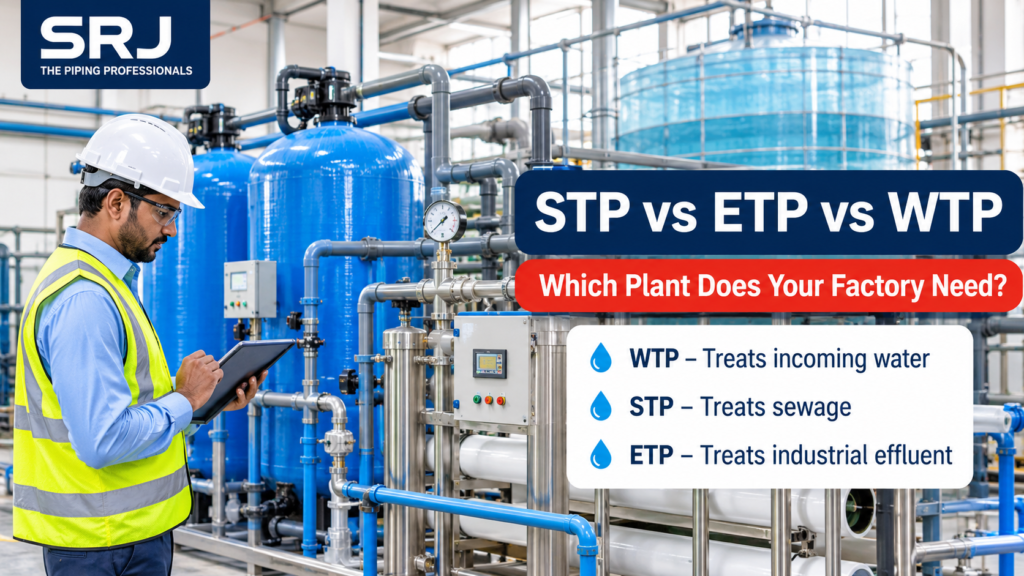
- WTP (water treatment plant) treats the water coming into your site, such as borewell, tanker, municipal or harvested rainwater, so it is fit for drinking, process, boiler or cooling use.
- STP (sewage treatment plant) treats domestic wastewater from toilets, washrooms and canteens.
- ETP (effluent treatment plant) treats industrial (trade) effluent from your manufacturing process, such as washing, plating, dyeing, pickling, cooling-tower blowdown, or contaminated floor wash.
Many factories need two of the three, and some need all three. The questions to ask are what water enters, what water leaves, and what is in it. “Which one is better” is the wrong question.
| Plant | What it treats | Source of water | Typical process | Main rule |
|---|---|---|---|---|
| STP | Domestic wastewater from toilets, washrooms and canteens | Sewage generated on site | Biological treatment (for example activated sludge, SBR, MBBR or MBR), often followed by filtration and disinfection when reuse is planned | Prior consent of KSPCB under Water Act s.25 (covers sewage as well as trade effluent) |
| ETP | Industrial (trade) effluent from the manufacturing process | Process wastewater (washing, plating, dyeing, pickling, blowdown, floor wash, and similar) | Physico-chemical primary treatment, biological secondary where biodegradable, then tertiary steps as the consent requires | Prior consent of KSPCB under Water Act s.25 for trade effluent |
| WTP | Incoming water so it is fit for drinking, process, boiler or cooling use | Borewell, tanker, municipal supply or harvested rainwater | Screening and settling, clarification, filtration, softening, RO where needed, and disinfection | Design to the end use (for example IS 10500 for drinking water); borewell use may need a groundwater permit in notified areas |
Water treatment plant (WTP): fixing your incoming water
Your raw water quality sets the WTP design. Typical stages include screening and settling, clarification, pressure sand and activated carbon filtration, softening (removing calcium and magnesium hardness that scales boilers and heat exchangers), reverse osmosis (RO) for high dissolved solids, and disinfection. For a broader look at why these plants matter, see our earlier post on the importance of water treatment plants.
What you need depends on the end use:
- Drinking water for workers: the national benchmark is IS 10500:2012 (Drinking Water — Specification) from the Bureau of Indian Standards. It sets an “acceptable limit” for each parameter, and for some parameters a higher “permissible limit in the absence of an alternate source.”
- Boiler feed, cooling towers, process water: these usually need tighter control of hardness, silica or dissolved solids, as set by the equipment maker or process. That is often stricter than drinking-water limits for some parameters and looser for others.
Employers have a legal duty to provide drinking water. Since the Occupational Safety, Health and Working Conditions Code, 2020 came into force on 21 November 2025 (replacing the Factories Act, 1948), that duty sits in the Code and its rules. Check the current Karnataka rules for the exact requirements.
Sewage treatment plant (STP): domestic wastewater
Every factory with toilets and a canteen produces sewage. It is mostly organic, so STPs use biological processes. Common options include activated sludge, extended aeration, sequencing batch reactors (SBR), moving bed biofilm reactors (MBBR) and membrane bioreactors (MBR). Most are followed by filtration and disinfection when the water will be reused.
Sizing starts from realistic sewage generation, based on headcount across shifts, canteen use and washroom fixtures. Don’t just copy a vendor’s catalogue capacity. An oversized biological plant starved of load can perform as badly as an undersized one.
Effluent treatment plant (ETP): process wastewater
Industrial effluent varies far more than sewage. It may contain oil and grease, heavy metals, acids or alkalis, dyes, solvents, high COD, or high dissolved solids. A typical ETP combines:
- Primary/physico-chemical treatment: equalisation, pH correction, oil skimming, coagulation–flocculation, and settling.
- Secondary (biological) treatment where the effluent is biodegradable.
- Tertiary treatment: filtration, activated carbon, and sometimes RO and evaporation where the consent requires minimal or zero liquid discharge.
ETP design must start with effluent characterisation: flow per shift, peak flows, and laboratory analysis of real or representative samples. Two factories in the same industrial area can need completely different ETPs.
Why the distinction matters for KSPCB consent
Under Section 25 of the Water (Prevention and Control of Pollution) Act, 1974, no one may establish or operate an industry, operation or process likely to discharge sewage or trade effluent without the prior consent of the State Pollution Control Board. In Karnataka that is the Karnataka State Pollution Control Board (KSPCB). KSPCB issues consent in two stages, Consent for Establishment (CFE) and Consent for Operation (CFO), and processes applications online through its XGN system.
Note that the law covers sewage as well as trade effluent. A factory with no process effluent still has domestic sewage, and the consent will set out how that is handled.
Your industry category drives the scrutiny
The Central Pollution Control Board (CPCB) classifies sectors by pollution potential. Its 2025 classification places 419 sectors and sub-sectors into Red, Orange, Green, White and Blue categories. The category affects consent validity, inspection frequency and siting. The Central Government has also exempted White category sectors (practically non-polluting) from Consent to Establish and Consent to Operate under the Water and Air Acts. They need to inform the State Board in writing instead. If your unit is not White category, expect your treatment plants to be examined closely at the CFE stage.
Discharge standards depend on where the water goes
The general standards for discharge of environmental pollutants (Schedule VI, Environment (Protection) Rules, 1986) set different limits for different destinations. For example, discharge to inland surface water is limited to BOD 30 mg/L, COD 250 mg/L, suspended solids 100 mg/L and pH 5.5–9.0. Discharge into public sewers with a terminal treatment plant has different limits. Sector-specific standards apply to many industries.
For STPs, the Ministry of Environment, Forest and Climate Change notified discharge standards in October 2017. In April 2019 the National Green Tribunal directed stricter norms (including BOD 10 mg/L and TSS 20 mg/L). Treat the conditions written in your own KSPCB consent as the binding numbers for your plant, and design to meet them with a margin.
Bengaluru-specific points to keep in mind
- Treated water reuse is expected. A March 2024 Karnataka government order (Forest, Ecology and Environment Department) kept STPs mandatory for residential, commercial and educational buildings above set size thresholds. It also requires that treated water use be accounted for. That order covers buildings rather than industries, but it shows where the state is heading: reuse of treated water for flushing, landscaping and cooling, not just disposal. Industrial consents may carry their own reuse conditions.
- Groundwater is regulated. If your WTP will draw from borewells, the Karnataka Ground Water Act, 2011 requires a permit for new wells in notified areas, and the Karnataka Ground Water Authority may attach conditions. Confirm the status of your location before planning a borewell-fed system.
- Industrial areas differ. Some industrial estates have sewer connections or common treatment facilities, and others do not. What you are allowed to discharge, and where, depends on the specific site and your consent.
How to work out what your factory needs: a five-step approach
- Map every water stream. Draw a simple water balance: sources (borewell, municipal, tanker, rainwater), then uses (drinking, process, boiler, cooling, washing, gardening), then outlets (sewage, process effluent, blowdown, rejects). Most later mistakes come from skipping this step.
- Characterise the water, don’t assume it. Test raw water against IS 10500 and your process needs. For existing units, sample effluent across shifts and production cycles. For new units, use process data and the experience of similar plants, and state your assumptions clearly.
- Decide what to keep separate. Segregating domestic sewage from process effluent, and high-strength streams from mildly contaminated ones, usually makes treatment simpler and reuse easier. Whether a combined plant is acceptable depends on effluent characteristics and your consent conditions.
- Size for real peaks and future expansion. Account for shift patterns, batch discharges and planned expansion. Equalisation tanks are often the cheapest insurance against shock loads. Leave physical space for a future tertiary stage, such as RO, if tighter reuse targets are likely.
- Plan operations, not just construction. A plant still needs trained operators, chemical dosing, sludge handling and disposal (ETP sludge can be classed as hazardous waste depending on the process), regular lab testing, and records for inspections and consent renewals. Budget for running costs and maintenance from day one.
Where piping and MEP fit in
Treatment plants rarely fail at the tank. They fail at the connections. Undersized gravity lines, poor slopes, wrong pipe material for corrosive effluent, missing sampling points and unplanned pump redundancy all cause trouble years later. Planning the water treatment plant, plumbing and process piping as one integrated MEP package makes it easier to pipe treated water back to flushing, cooling or gardening without retrofits. Where a site also has a separate STP or ETP, the same connection planning still matters for the interfaces around those plants.
Frequently asked questions
What is the difference between STP and ETP?
An STP (sewage treatment plant) treats domestic wastewater from toilets, washrooms and canteens. An ETP (effluent treatment plant) treats industrial (trade) effluent from the manufacturing process. Sewage is mainly organic and biodegradable; process effluent can contain oils, metals, extreme pH or other substances that need different treatment. Many sites keep the two streams separate.
Is KSPCB consent required for an STP?
Under Section 25 of the Water (Prevention and Control of Pollution) Act, 1974, prior consent of the State Pollution Control Board is required before establishing or operating an industry, operation or process likely to discharge sewage or trade effluent. In Karnataka that board is KSPCB. The law covers sewage as well as trade effluent, so a factory that has only domestic sewage is still within the consent framework. Whether you need an on-site STP, and what conditions apply, depends on your location, industry category and the conditions written in your consent. Confirm specifics with KSPCB or a qualified environmental consultant.
Can one plant treat both sewage and industrial effluent?
Sometimes, but not by default. Sewage is mainly organic and biodegradable. Industrial effluent may contain substances that disrupt biological treatment, such as metals, oils or extreme pH. Many sites segregate the streams and pre-treat process effluent. The acceptable arrangement depends on your effluent analysis and the conditions in your KSPCB consent.
Does a small factory with no process wastewater need an STP?
It still produces domestic sewage, and the Water Act’s consent requirement covers sewage as well as trade effluent. Whether you need an on-site STP or can discharge to a sewer depends on your location, your industry category and your consent conditions. Check with KSPCB, or with a consultant familiar with its process, before finalising the design.
Is a WTP the same as an RO plant?
No. RO is one possible stage inside a WTP and is used mainly to reduce dissolved solids. Many water sources only need filtration, softening and disinfection. RO also produces a reject stream that must be managed, so use it where the water quality actually calls for it.
What standards should treated water meet before discharge or reuse?
It depends on where the water goes. The general standards under Schedule VI of the Environment (Protection) Rules, 1986 vary by destination (inland surface water, public sewer, land for irrigation, marine). Many sectors have specific standards. The binding limits for your unit are those written in your KSPCB consent.
What information should I have ready before asking for a treatment plant proposal?
Have your water sources and daily consumption, headcount across shifts, canteen details, a description of each process that uses water, any existing test reports, your industry category, available space, and your reuse goals. The better this data, the more accurate the design and the quote.
Planning water treatment for your facility?
SRJ Group has worked in industrial projects since 1985. Our water treatment work covers reverse osmosis, softening, clarification and wastewater reuse, along with industrial piping, MEP services, fire protection systems, and structural steel fabrication and erection. We do not design, build, install or operate STPs or ETPs. If you need a water treatment plant for your site, or piping and MEP connections around a treatment system, contact our team to discuss your requirements. You can also read more about our water treatment plant services.
This article is general information, not legal advice. Pollution-control requirements depend on your industry, location and consent conditions; confirm specifics with KSPCB or a qualified environmental consultant.