Industrial projects are not just about building structures. They are about creating safe, efficient, and future-ready facilities that can perform reliably for years.
Whether it is a manufacturing plant, warehouse, airport facility, commercial building, pharmaceutical unit, food processing facility, or large infrastructure project, every system inside the facility must work together. Fire protection, industrial piping, mechanical systems, electrical systems, plumbing, structural fabrication, and water treatment cannot be treated as separate afterthoughts.
This is where choosing a turnkey industrial contractor makes a major difference.
A turnkey contractor manages the entire journey from design and planning to fabrication, installation, testing, commissioning, and long-term maintenance. For businesses, this means fewer coordination issues, better accountability, faster execution, and safer project outcomes.
A turnkey industrial contractor is responsible for delivering a complete solution rather than handling only one part of the project.
Instead of hiring separate vendors for fire protection, MEP systems, piping, fabrication, and maintenance, a turnkey partner brings all critical services under one coordinated execution plan.
For industrial clients, this is extremely valuable because every delay, design mismatch, or installation error can affect production, safety compliance, and operational cost.
A good turnkey contractor helps with:
The goal is simple: deliver a reliable industrial infrastructure system that is safe, efficient, and ready for operations.
Industrial piping is one of the most important systems inside any factory or process-driven facility.
It supports the movement of water, compressed air, steam, gases, chemicals, process fluids, and other utilities required for daily operations. Poorly designed or badly installed piping can lead to leakage, pressure loss, downtime, safety risks, and expensive rework.
A professional industrial piping contractor ensures that the piping system is designed according to the facility’s actual usage, pressure requirements, safety needs, and long-term expansion plans.
For factories, this means:
Industrial piping should never be treated as basic plumbing. It is a core part of the facility’s performance.
Fire safety is one of the most important investments for any industrial, commercial, or infrastructure project.
Factories, warehouses, production units, electrical rooms, storage areas, and high-risk industrial zones need properly designed fire protection systems. A weak fire safety setup can put lives, assets, machinery, inventory, and business continuity at risk.
A reliable fire protection system may include:
The key is not just installing equipment. The system must be designed correctly, installed with precision, tested properly, and maintained regularly.
This is why working with an experienced fire protection systems contractor in Bangalore or anywhere in India is important for factories, warehouses, and commercial facilities.
MEP stands for Mechanical, Electrical, and Plumbing. These systems are the backbone of any modern building or industrial facility.
A well-designed MEP system ensures that the facility functions smoothly, safely, and efficiently. This includes ventilation, HVAC, electrical distribution, lighting, water supply, drainage, fire alarms, and other essential building services.
Poor MEP coordination can cause major problems such as:
When MEP systems are planned along with fire protection, piping, and structural requirements, the entire project becomes more efficient.
This is where a turnkey MEP contractor adds real value.
Every industrial project needs strong, durable, and well-engineered structural support.
Heavy structural fabrication is used in platforms, pipe supports, equipment structures, industrial sheds, utility structures, access systems, and other steel-based infrastructure.
The quality of fabrication directly affects safety, durability, and long-term performance.
A reliable structural fabrication contractor focuses on:
For industrial and infrastructure projects, fabrication is not only about making steel structures. It is about creating safe and functional support systems that fit the project’s exact requirements.
Many companies try to save money by hiring separate contractors for piping, fire protection, MEP, fabrication, and maintenance.
On paper, this may look cheaper. In reality, it often creates hidden costs.
Common problems include:
For example, if the fire pipeline route clashes with an electrical or HVAC system, the project may need redesign, extra labour, material wastage, and delayed delivery.
A turnkey contractor reduces these risks by planning all systems together from the beginning.
A design-to-commissioning approach means the contractor is involved from the early planning stage until the final handover.
This creates a smoother project flow because the same team understands the design, site conditions, installation challenges, safety requirements, and final performance expectations.
The benefits include:
For industrial clients, this saves time, money, and operational stress.
Before selecting a contractor for your factory, warehouse, commercial facility, or infrastructure project, look beyond the lowest quote.
The right contractor should have:
A contractor who understands multiple systems can provide better recommendations and prevent costly mistakes before they happen.
Industrial projects demand practical knowledge. Every site has different challenges, space constraints, safety requirements, utility needs, and timelines.
An experienced contractor can identify risks early and offer solutions that are both technically sound and practical to execute.
Experience also helps in:
In industrial infrastructure, experience is not just a credential. It directly affects project quality.
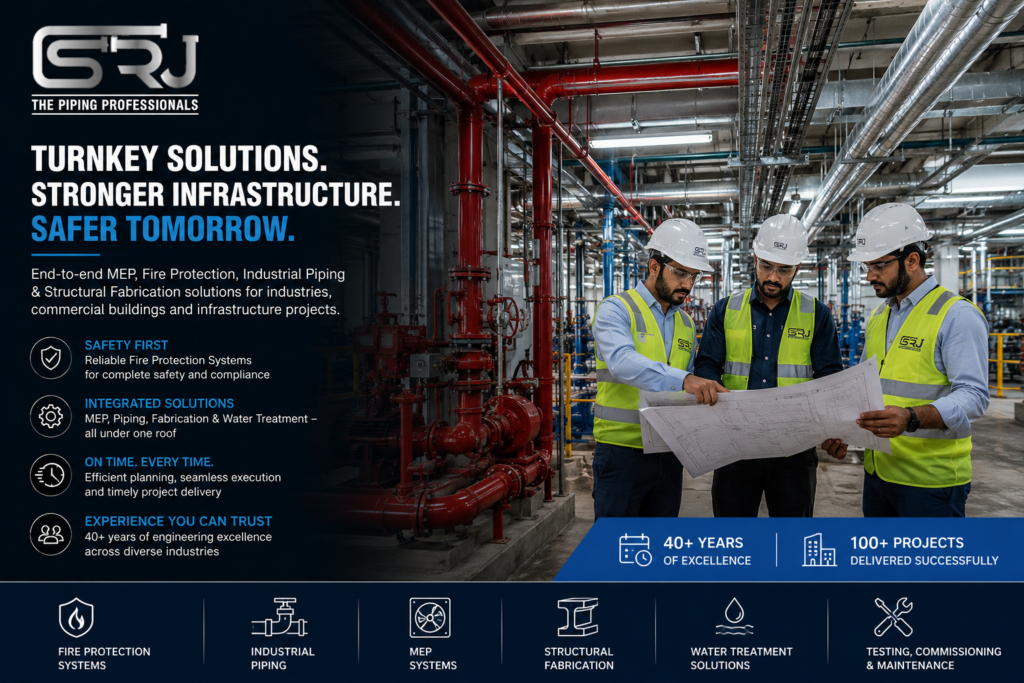
SRJ Piping India Pvt. Ltd. provides end-to-end industrial infrastructure solutions across fire protection systems, industrial piping, heavy structural fabrication, MEP systems, and water treatment plant solutions.
With decades of engineering expertise, SRJ Group supports factories, warehouses, commercial buildings, infrastructure projects, and industrial facilities with design, fabrication, installation, testing, commissioning, and maintenance-focused execution.
From fire safety systems to process piping and integrated MEP solutions, SRJ works with a clear focus on safety, reliability, quality, and long-term performance.
Industrial infrastructure is too important to be handled in disconnected parts.
Fire protection, MEP systems, industrial piping, structural fabrication, and water treatment must work together as one integrated system. Choosing a turnkey industrial contractor helps businesses reduce risk, improve safety, speed up execution, and create facilities that are ready for long-term operations.
For factories, warehouses, manufacturing units, commercial spaces, and infrastructure projects, the right contractor is not just a vendor.
The right contractor becomes a long-term engineering partner.
A turnkey industrial contractor manages the complete project scope from design and planning to fabrication, installation, testing, commissioning, and handover.
Factories should hire a turnkey contractor because it reduces coordination issues, improves accountability, saves time, and ensures that all systems are planned together.
Industrial piping can include process piping, utility piping, compressed air lines, water lines, fire pipelines, gas lines, and other piping systems required for factory operations.
Fire protection systems protect people, machinery, inventory, buildings, and business continuity. They are essential for safe and compliant industrial operations.
An MEP contractor handles mechanical, electrical, and plumbing systems such as HVAC, electrical distribution, lighting, water supply, drainage, ventilation, and safety-related building services.
Look for experience, technical capability, turnkey execution, safety standards, skilled manpower, past projects, and expertise across fire protection, piping, MEP, and structural fabrication.
SRJ Piping India delivers turnkey industrial piping, fire protection, MEP, structural fabrication, and water treatment solutions for industrial, commercial, and infrastructure projects.
Contact SRJ Piping India today to discuss your project requirements and get a customized engineering solution.
SRJ Piping India is your trusted partner. Give us a call for a free consultation