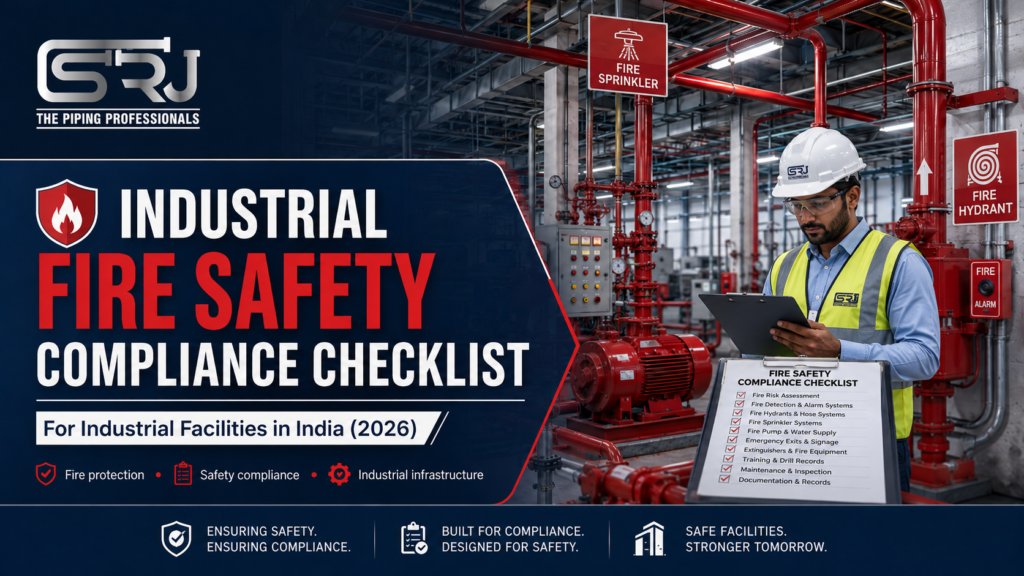
As industrial facilities become larger and more complex, fire safety is no longer just a regulatory requirement—it is a critical investment in business continuity, employee safety, and asset protection.
Whether you operate a manufacturing plant, warehouse, logistics park, commercial complex, airport, pharmaceutical facility, or industrial processing unit, a well-designed fire protection system can prevent catastrophic losses and ensure compliance with Indian fire safety regulations.
At SRJ Piping India, we have spent over four decades delivering turnkey fire protection systems for industrial and commercial projects across India, helping clients build safer and more resilient facilities.
Every facility should begin with a professional fire risk assessment that identifies:
A detailed assessment forms the foundation of an effective fire protection strategy.
Every facility has unique requirements. Depending on your operations, a compliant fire protection solution may include:
Selecting the appropriate system depends on occupancy type, fire load, and applicable standards.
Industrial fire protection systems should be designed and installed in accordance with applicable Indian regulations and recognized engineering standards.
Compliance helps ensure:
Working with experienced contractors helps ensure systems meet both statutory and project-specific requirements.
Installing a fire protection system is only the first step.
Routine inspections should include:
Preventive maintenance significantly improves system reliability during emergencies.
Even the best fire protection systems require trained personnel.
Conduct periodic:
Prepared employees reduce panic and improve emergency outcomes.
Fire protection piping must remain free from:
Routine inspections ensure uninterrupted water supply during critical situations.
Certain industrial areas require additional protection, including:
These locations often require enhanced fire suppression and monitoring systems.
A complete compliance record should include:
Accurate documentation simplifies audits and regulatory inspections.
Fire protection projects involve multiple engineering disciplines including:
Partnering with an experienced turnkey contractor minimizes coordination challenges and improves project quality.
With over 40 years of engineering expertise, SRJ Piping India has successfully executed projects across:
Our integrated capabilities include:
We focus on delivering engineering excellence, safety, quality, and long-term reliability for every project.
A typical system may include fire hydrants, sprinklers, fire pumps, hose reels, alarm systems, water storage tanks, extinguishers, and detection equipment depending on the facility’s requirements.
Routine inspections should be carried out according to the maintenance schedule recommended for the installed systems and applicable regulations. Critical equipment should be tested regularly to ensure readiness.
Preventive maintenance helps identify issues before they become failures, ensuring the system performs effectively during an emergency while extending equipment life.
Fire protection systems are essential for manufacturing plants, warehouses, pharmaceutical facilities, commercial buildings, airports, logistics hubs, data centers, food processing plants, and other industrial facilities.
A turnkey contractor manages design, engineering, installation, testing, commissioning, and maintenance under one roof, resulting in better coordination, quality control, and timely project delivery.
Whether you’re planning a new industrial facility, upgrading an existing fire protection system, or looking for a trusted turnkey engineering partner, SRJ Piping India has the expertise to deliver reliable, compliant, and future-ready solutions.
Contact us today to discuss your project requirements and discover how our engineering team can help protect your people, assets, and operations.
Website: https://srjpipingindia.com
Get in touch: Request a consultation for your next fire protection, industrial piping, MEP, structural fabrication, or turnkey engineering project.
SRJ Piping India is your trusted partner. Give us a call for a free consultation : +918041663637