
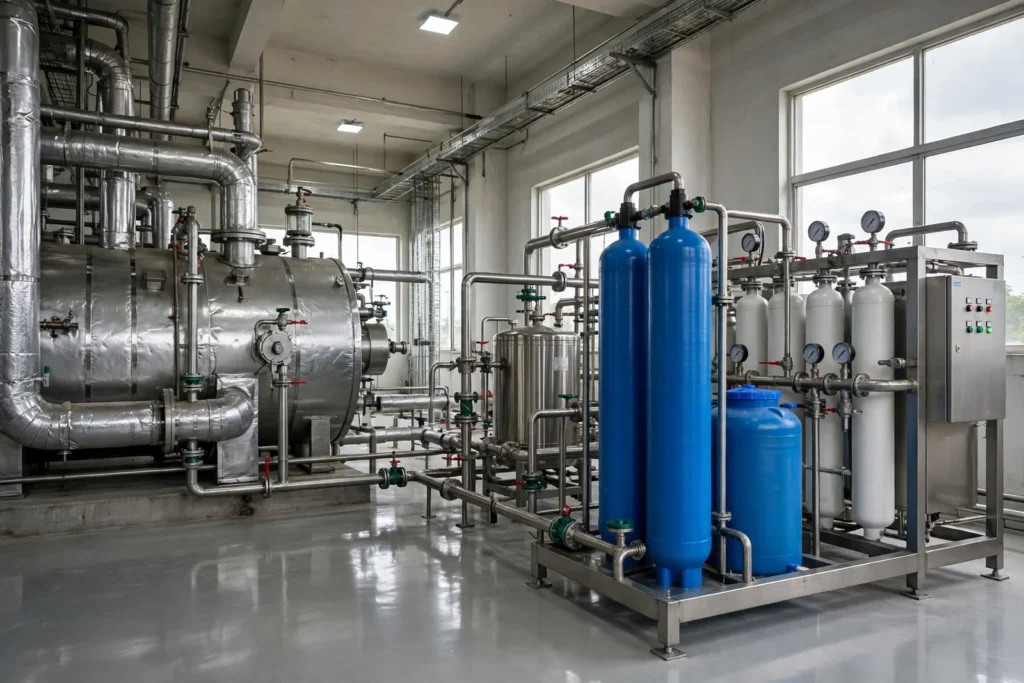
If your factory runs a steam boiler, the water you feed it decides how long the tubes last, how often you descale, and what the Inspector of Boilers sees in your records. Boiler feed water treatment used to be handled by habit: “put in a softener and add chemicals.” Since the Indian Boiler Regulations, 2026 (IBR 2026) were published on 1 October 2026, the feed water and boiler water limits sit in a dedicated chapter of the regulations. That makes this a good time to check whether your treatment plant still fits your boiler.
This guide is for plant heads, maintenance managers and project teams in Bengaluru and across Karnataka. It covers what IBR 2026 actually specifies, how to read your raw water report, when a water softener is enough and when you need RO, and what to ask before you buy a treatment system.
Note: This article is general guidance, not a design. Your boiler maker’s instructions, a current raw water analysis and the Inspector of Boilers have the final word for your installation.
Why boiler feed water quality matters
Water that looks clear can still damage a boiler. Three problems cause most of the trouble:
- Scale. Calcium and magnesium (hardness) and silica come out of solution on hot surfaces. Scale insulates the tubes, so the metal runs hotter and fuel is wasted.
- Corrosion. Dissolved oxygen and the wrong pH attack steel in the feed line, the economiser and the boiler. Oxygen pitting can lead to tube leaks.
- Carryover. When dissolved solids in the boiler water climb too high, water and impurities can be carried into the steam. That can foul steam traps, heat exchangers and product lines.
Good boiler feed water treatment controls all three. It does that with external treatment before the boiler (filtration, softening, RO, deaeration) and internal conditioning and blowdown inside it.
What IBR 2026 says about feed water
The Boilers Act, 2025 replaced the Boilers Act, 1923. IBR 2026 was made under Section 40 of that Act, published in the Gazette of India (Extraordinary, No. 596) on 1 October 2026 and came into force on publication. It supersedes the Indian Boiler Regulations, 1950. We covered the approval side of steam lines in our post on IBR steam pipeline approval in Karnataka.
Chapter 15, “Feed Water for Boiler” (regulations 556 to 559) sets the water quality rules:
- Scope (reg. 556): the chapter’s limits apply to low and medium pressure boilers operating up to 60 kg/cm² (g). For boilers operating above 60 kg/cm² (g), the regulation says better quality water to IS 10496 shall be adopted.
- Requirements (reg. 557): water must meet Table 15/1 when tested by the listed methods.
- Sampling (reg. 558): follow IS 3025 (Part 2). Fit a stainless steel or monel cooling coil on the sampling cock so the sample does not flash. Take feed water samples at the boiler feed pump delivery, boiler water from the top drum, and condensate at the condensate extraction pump delivery.
- Test methods (reg. 559): IS 3025 and IS 3550, as indicated in the table.
Key limits in Table 15/1 (low and medium pressure boilers)
| Parameter | Up to 20 kg/cm² (g) | 21 to 39 kg/cm² (g) | 40 to 60 kg/cm² (g) |
|---|---|---|---|
| Feed water total hardness (as CaCO₃), mg/l, max | 5 | 2 | Nil |
| Feed water pH | 8.8 to 9.5 | 8.8 to 9.5 | 8.8 to 9.5 |
| Feed water dissolved oxygen, mg/l, max | not specified | 0.5 | 0.5 |
| Feed water silica (as SiOâ‚‚), mg/l, max | not specified | 0.5 | 0.5 |
| Boiler water total alkalinity (as CaCO₃), mg/l, max | 700 | 500 | 300 |
| Boiler water pH | 9.0 to 12.0 | 9.0 to 12.0 | 9.0 to 11.0 |
| Boiler water total dissolved solids, mg/l, max | 3,500* | 2,500 | 1,500 |
| Boiler water silica (as SiOâ‚‚), mg/l, max | not specified | 15 | 15 |
*The table notes that for shell type boilers the TDS limit can be relaxed depending on parameters. The table also gives ranges for residual sodium sulphite, hydrazine and phosphate where those chemicals are used. Its notes require completely demineralised feed water for recovery boilers, and set feed water pH ranges for systems with copper alloy or iron feed water heaters.
Source: IBR 2026, Chapter 15, Table 15/1, as printed in the Gazette. Always check the Gazette text for your boiler’s pressure class before you design or buy.
The BIS standards behind it
The Bureau of Indian Standards lists IS 10392:2026 (feed water and boiler water for low and medium pressure boilers, first revision) and IS 10496:2024 (feed water, boiler water and condensate for high pressure boilers) as published standards. IS 10392:2026 replaces the 1982 edition that many older water treatment proposals still quote. If a vendor’s offer cites “IS 10392:1982”, ask them to check it against IS 10392:2026 and the IBR 2026 table.
Feed water quality now appears in inspection paperwork
Form IX of IBR 2026 lists the details to send with an application for boiler inspection after twelve or thirty-six months of certification. One of the items is “Quality of boiler feed water”. Keeping regular, dated water test records is simply good practice, and it makes that item easy to answer.
Step 1: Get a proper raw water analysis
Every treatment decision starts with the water you actually have. Factories in Karnataka draw from different sources, such as borewells, industrial area supply, municipal supply, tankers or a mix of these. Quality can change with source and season, so one old report is not enough.
Ask an accredited laboratory to test, at minimum:
- Total hardness, calcium hardness and magnesium hardness
- Total dissolved solids (TDS) and conductivity
- Alkalinity (P and M), pH
- Silica
- Iron and manganese
- Chlorides and sulphates
- Turbidity and suspended solids
- Free chlorine, if the source is chlorinated
If you use more than one source, test each one, and test again whenever the source changes. Share the report with your treatment designer and your boiler maker.
Step 2: Understand the treatment options
Filtration (pre-treatment)
Pressure sand filters or multimedia filters remove suspended solids and turbidity. Activated carbon filters remove free chlorine and some organics. Chlorine matters because it can damage softener resin and many RO membranes. Filtration does not reduce hardness or dissolved salts.
Water softener (sodium ion exchange)
A softener passes water through a bed of cation resin in the sodium form. The resin swaps the calcium and magnesium (hardness) for sodium. When the resin is exhausted, it is regenerated with salt (sodium chloride) brine, and the hardness leaves in the waste brine and rinse water (Veolia Water Handbook, ion exchange chapter). The handbook notes softened water is used for low to medium pressure boiler feed water and as RO make-up.
What a softener does not do: it does not reduce TDS, alkalinity or silica. The sodium simply replaces the hardness. If your raw water already has high TDS or silica, a softener alone can keep hardness in limit while TDS in the boiler climbs, which means more blowdown.
Reverse osmosis (RO)
RO pushes water through a semi-permeable membrane under pressure. It reduces dissolved salts, including hardness, TDS and much of the silica. That helps you meet boiler water TDS and silica limits with less blowdown. RO needs good pre-treatment (filtration, dechlorination and either softening or antiscalant dosing, depending on the design) and it produces a continuous reject stream that has to be handled.
Demineralisation (DM) and mixed bed polishing
Cation-anion ion exchange or RO followed by mixed bed polishing produces very low-conductivity water. It is needed for recovery boilers under the IBR 2026 table notes and for higher pressure boilers covered by IS 10496. Most small and medium factory boilers do not need DM, but your boiler pressure and maker’s spec decide.
Deaeration and chemical conditioning
Removing hardness and salts does not remove dissolved oxygen. Higher pressure classes in Table 15/1 limit feed water dissolved oxygen to 0.5 mg/l. Plants use a deaerator or a hot feed tank, plus an oxygen scavenger such as sodium sulphite, and pH and phosphate conditioning. The table gives residual ranges for these chemicals where they are used.
Condensate return and blowdown
Returning clean condensate cuts the amount of make-up water you have to treat. Blowdown, continuous or intermittent, keeps boiler water TDS and alkalinity within limits. A good treatment design looks at make-up, condensate return and blowdown together.
Water softener vs RO for boiler feed water
| Water softener | RO plant (with pre-treatment) | |
|---|---|---|
| Removes hardness | Yes | Yes (mostly) |
| Reduces TDS | No | Yes |
| Reduces silica | No | Largely |
| Reduces alkalinity | No | Largely |
| Main waste stream | Regeneration brine and rinse water | Continuous reject water |
| Consumables | Salt, resin replacement | Antiscalant, cartridge filters, membranes, cleaning chemicals |
| Typical fit | Low pressure boilers on low TDS, low silica raw water | Higher TDS or silica water, or where blowdown losses are high |
There is no universal answer. A softener is often enough for a low pressure boiler on good quality water. Where TDS or silica is high, or the boiler pressure is higher, RO (often with a softener or antiscalant ahead of it) is usually the better fit. Your raw water analysis, the boiler’s pressure class and the maker’s water spec should settle it.
Do not forget the wastewater
Softener regeneration brine, RO reject and boiler blowdown are all wastewater streams. Under Section 25 of the Water (Prevention and Control of Pollution) Act, 1974, a unit likely to discharge trade effluent needs the State Board’s prior consent, and that includes any extension or addition to a treatment system. In Karnataka that is the Karnataka State Pollution Control Board (KSPCB), which handles Consent for Establishment and Consent for Operation through its online consent system.
Before you add or change a water treatment plant, check your existing consent conditions on how these streams must be handled and discharged. If you are unsure whether a change needs an amendment, ask KSPCB first. Our STP vs ETP vs WTP explainer covers how these plants differ.
Piping and layout points that are easy to miss
- Sampling points: provide them where IBR 2026 asks for samples, at the feed pump delivery, the top drum and the condensate extraction pump delivery, with a stainless steel or monel sample cooler.
- Treated water storage: size the treated water tank for regeneration or cleaning downtime, so the boiler never runs on raw water.
- No raw water bypass to the boiler: if a bypass exists for maintenance, keep it locked and logged.
- Material selection: treated water, RO permeate and brine are aggressive in different ways. Choose pipe, valve and tank materials for each stream rather than one material for everything.
- Metering: fit flow meters on make-up and condensate return so you can see what is happening.
- Steam line link: feed water treatment and steam piping work together. See our article on preventing steam piping accidents.
Questions to ask before you buy a boiler water treatment plant
- Which raw water analysis is the design based on, and how recent is it?
- Which boiler pressure class and which Table 15/1 column is the design meant to meet?
- Does the offer reference IS 10392:2026 (or IS 10496:2024 for high pressure boilers), not the superseded 1982 edition?
- What feed water hardness, TDS and silica will the plant deliver at full flow and at end of cycle?
- What is the treated water flow, and how does it match your peak steam demand and condensate return?
- What waste streams will it produce, how much, and how will they be handled under your KSPCB consent?
- What consumables (salt, antiscalant, cartridges, membranes) will it need, and what does the operator have to do each day?
- Which sampling points, test kits and records come with it?
- Who commissions it, and what training and documents do you receive?
- How will the plant connect to your existing feed tank, deaerator and boiler piping?
Frequently asked questions
Boiler feed water treatment is the set of processes that make water fit to enter a boiler. It usually includes filtration, softening or RO to remove hardness and salts, deaeration and chemical conditioning to control oxygen and pH, plus blowdown and condensate management.
Under Table 15/1 of IBR 2026, feed water total hardness (as CaCO₃) must not exceed 5 mg/l for boilers up to 20 kg/cm² (g), 2 mg/l for 21 to 39 kg/cm² (g), and must be nil for 40 to 60 kg/cm² (g). Boilers above 60 kg/cm² (g) must use better quality water to IS 10496.
For many low pressure boilers on low TDS, low silica water, a well run softener plus correct chemical conditioning and blowdown is enough. A softener does not reduce TDS, alkalinity or silica, so it may not be enough where raw water has high dissolved solids or where boiler pressure is higher.
Consider RO when raw water TDS or silica is high, when blowdown losses are large, or when your boiler’s pressure class needs tighter limits. RO needs proper pre-treatment and produces a reject stream that must be handled under your pollution control consent.
IBR 2026 Chapter 15 sets the limits for boilers up to 60 kg/cm² (g). BIS lists IS 10392:2026 for low and medium pressure boilers and IS 10496:2024 for high pressure boilers. Your boiler maker’s manual may set tighter values.
IBR 2026 regulation 558 asks for feed water samples at the boiler feed pump delivery, boiler water from the top drum, and condensate from the condensate extraction pump delivery, using a stainless steel or monel cooling coil so the sample does not flash.
They are wastewater streams. Under Section 25 of the Water Act, units likely to discharge trade effluent, including extensions to treatment systems, need the State Board’s prior consent. Check your KSPCB consent conditions, and ask KSPCB if you are unsure whether a change needs an amendment.
Planning boiler feed water treatment in Karnataka?
Since 1985, SRJ Group has delivered industrial piping and water treatment plant work for factories. Our water treatment work includes softening plants and RO systems, along with the industrial piping that connects them to your plant. If you are planning or upgrading boiler feed water treatment in Karnataka, contact us with your raw water test report and boiler details, and we can discuss a suitable treatment arrangement.
Sources
- Indian Boiler Regulations, 2026, Gazette of India Extraordinary, Part III Section 4, No. 596, 1 October 2026: Chapter 15 (regs 556 to 559, Table 15/1), reg. 1(3) commencement, Form IX item 17. Copy hosted by Chhattisgarh Invest portal: https://invest.cg.gov.in/boiler-knowledge-management/download/Indian%20Boiler%20Regulations,%202026.pdf
- Bureau of Indian Standards, Programme of Work, CHD 13 Water Quality for Industrial Purposes (lists IS 10392:2026 and IS 10496:2024): https://www.services.bis.gov.in/php/BIS_2.0/bisconnect/pow_new/Pow/download_pow_pdf_dept_commtt/62/176/
- Water (Prevention and Control of Pollution) Act, 1974, Section 25: https://indiankanoon.org/doc/1166145/
- Karnataka State Pollution Control Board, Procedure for Obtaining Consent: https://kspcb.karnataka.gov.in/node/1122
- Veolia Water Technologies, Water Handbook, Chapter 8, Ion Exchange (sodium zeolite softening): https://www.watertechnologies.com/handbook/chapter-08-ion-exchange
- Khaitan & Co, “Indian Boiler Regulations, 2026” (Ergo update, 23 October 2026): https://www.khaitanco.com/sites/default/files/2026-10/Ergo_Indian%20Boiler_IBR_23%20October%202026.pdf