A new boiler, compressed air plant, chiller or process line brings the same question: how will the pipes get from A to B? In most factories the answer is a pipe rack or a set of pipe supports. Both are simple steelwork, yet they hold up pressurised lines for decades. Designed late or bought on price alone, they cause problems later: sagging lines, cracked welds at supports, no room for the next utility, and rust where water collects.
This guide is for plant heads, project engineers and factory owners in Bengaluru and across Karnataka who are planning pipe rack fabrication or new pipe supports. It covers what to ask for, what your contractor needs from you, which standards apply, and the mistakes worth avoiding.
Note: This article is general guidance, not a design. A qualified structural engineer and, for process lines, a piping engineer must design your rack and supports for your actual loads and site.
Pipe rack or pipe supports: what is the difference?
Pipe supports are the elements that carry an individual pipe and control how it moves. Common types include:
- Resting (sliding) supports such as shoes or saddles that carry weight but let the pipe slide.
- Guides that allow movement along the pipe but stop sideways movement.
- Anchors (fixed points) that hold the pipe in place so expansion is directed where the designer wants it.
- Hangers, including rods, pipe support clamps and spring hangers, that hold pipes from above.
- Brackets, trapezes and wall or column supports for smaller lines inside a building.
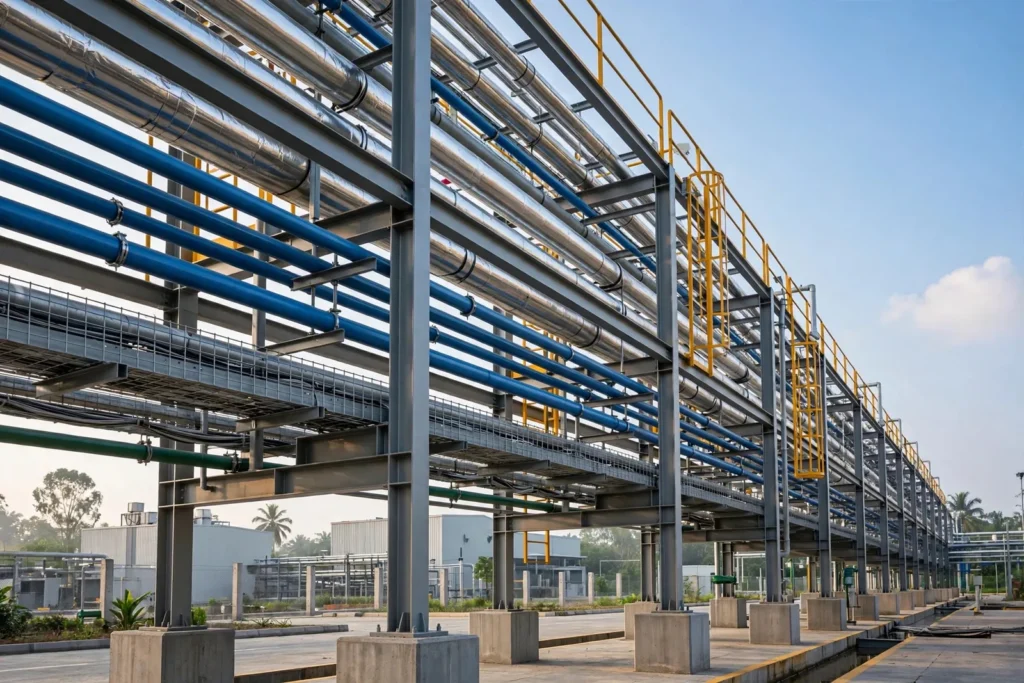
A pipe rack is a structure that carries many pipes (and often cable trays) together. It is usually a series of steel portal frames, called bents, linked by longitudinal beams, running between buildings, along a plant road or through a utility area.
In short: the supports hold the pipe; the rack holds the supports. A buyer usually needs both, and they must be designed together. If you are looking at supports for machinery rather than pipes, see our earlier guide to preventing equipment support structure failures.
Types of pipe racks used in factories and plants
Single-tier and multi-tier racks
A single-tier rack carries all lines at one level. It suits a small number of utility lines. A double-tier or multi-tier rack stacks lines on two or more levels. Designers often place larger, heavier lines on one tier and smaller lines, instrument air or cable trays on another, and they keep space between tiers for branch connections, maintenance and future lines.
Shop-fabricated, site-assembled and modular racks
- Site-built racks are cut, fitted and welded largely at site. They suit brownfield work around existing services, but site welding, painting and quality control are harder.
- Shop-fabricated, bolted racks are cut, drilled, welded and painted in a workshop, then bolted together at site. Quality is easier to control and site work is quicker.
- Modular (pre-assembled) racks go further: rack sections are built with some piping, cable trays or walkways already installed, then lifted into place. They need careful transport and lifting planning, and road access to site.
Our earlier article on pipe fabrication vs modular piping covers the same choice for the piping itself.
Structural steel or proprietary channel systems
Most outdoor pipe racks use hot-rolled structural sections. For light indoor services, proprietary slotted channel and clamp systems are quick to install, but their load ratings come from the manufacturer, so check them against your actual pipe loads.
What the buyer must give the contractor
A rack is only as good as its design inputs. Before you ask for a quotation, prepare as much of this as you can.
1. A pipe and services list
For every line: service, size, material, insulation thickness, operating and design temperature and pressure, and contents. Water-filled lines weigh far more than gas lines of the same size. Include cable trays, instrument tubing and any walkways.
2. Loads, including test conditions
Ask your piping designer for support loads: pipe weight with contents and insulation, friction from sliding lines, anchor forces, and any occasional loads. Remember hydrostatic test loads: a gas or steam line filled with water for testing can weigh much more than it does in service. Our guide to hydro testing and pneumatic testing of process piping explains when each test is used.
3. Thermal expansion and movement
Hot lines such as steam and condensate grow as they heat up, and the rack must let them move where the piping designer intends. That means agreeing anchor and guide positions, expansion loop locations and the space a loop needs on the rack. Steam lines in Karnataka may also fall under the Indian Boiler Regulations; see our article on IBR steam pipeline approval in Karnataka before you finalise routing and supports.
4. Future expansion
Plants grow. A common practice is to keep spare space on each tier for future lines, but the right allowance is a design decision for your plant. Whatever you choose, make sure the steel and foundations are designed for the future load, not only today’s lines.
5. Clearances and access
State the clear heights you need under the rack for vehicles, forklifts and cranes, and the access needed to valves, flanges, steam traps and instruments. Decide early whether you need platforms, ladders or walkways for maintenance.
6. Site information
Give the contractor the site layout, soil report if available, existing underground services and any constraints near running plant. Foundations and anchor bolts often take the longest on a rack job.
Standards that apply to pipe racks and pipe supports
Standards change. Ask your designer to state the edition of each code on the drawings.
Steel design: IS 800
IS 800 is the Indian code of practice for general construction in steel. The Bureau of Indian Standards (BIS) established IS 800:2026 (Fourth Revision) on 28 October 2026. Under the BIS notification, IS 800:2007 remains in force alongside it until it is withdrawn on 28 April 2027. If your project is being designed now, ask your designer which edition they are using and why.
Structural steel: IS 2062
Structural sections and plates in India are usually specified to IS 2062. BIS now lists IS 2062 (Part 1):2025 for hot-rolled medium and high tensile structural steel. Ask for mill test certificates that state the standard and grade, and check that the material on site matches them.
Loads: IS 875 and IS 1893
- IS 875 covers design loads: Part 1 (dead loads, now IS 875 (Part 1):2026), Part 2 (imposed loads) and Part 3 (wind loads, 2015, with amendments). Outdoor racks with cable trays, walkways or cladding can attract significant wind load. Bengaluru’s basic wind speed in IS 875 (Part 3) is 33 m/s, but the design wind speed also depends on terrain, height and other factors. Coastal Karnataka sites need their own check.
- IS 1893 covers earthquake-resistant design. Under IS 1893 (Part 1):2016, Bengaluru is in Seismic Zone II, while the Government has listed Mangaluru and Uttara Kannada in Zone III. BIS also publishes IS 1893 (Part 4):2024 for industrial structures; your designer will decide whether and how it applies to your rack.
Piping codes and support standards
- ASME B31.3 (Process Piping), current edition 2024, covers design, fabrication, erection, examination and testing of process piping in many types of plants. Its piping support section sets out what supports must do, such as carrying weight, allowing thermal movement and resisting occasional loads. It does not cover the design of the supporting steel structure itself, which is why IS 800 still applies to the rack.
- MSS SP-58 (Pipe Hangers and Supports), current edition 2025, covers materials, design, manufacture, selection, application and installation of pipe hangers and supports. It is widely referred to for standard support components such as clamps, rods and spring hangers.
Not every factory line is B31.3 piping. Fire water, steam under IBR and building services can fall under other codes, so ask your contractor which code governs each line.
Fabrication, erection and welding
BIS publishes IS 7215 (tolerances for fabrication of steel structures), IS 7205 (safety code for erection of structural steel work), IS 816 (metal arc welding for general construction in mild steel) and IS 9595 (metal arc welding of carbon and carbon manganese steels). Your specification should say which welding standard applies, how welders are qualified and what inspection is required.
Corrosion protection
- ISO 12944 is the international series on corrosion protection of steel structures by protective paint systems. Part 2 (2017) classifies environments into corrosivity categories, which then guide the paint system choice.
- In India, IS 1477 (Parts 1 and 2) covers pretreatment and painting of ferrous metals in buildings, and IS 2629 (Part 1):2025 covers hot-dip galvanising of iron and steel.
Corrosion protection in the Bangalore climate
Bengaluru is inland, but racks still face monsoon rain, damp spells and, in many plants, cooling tower drift, steam leaks, chemical fumes or wash-down water. Corrosion on a rack usually starts in the same places:
- at pipe shoes and saddles, where steel rubs on steel and the paint wears off;
- at connections, base plates and anywhere water can collect;
- under insulation on cold or intermittently hot lines;
- at site welds and bolt holes that were never properly primed.
Practical steps: agree the corrosivity category and paint system before fabrication; specify surface preparation (such as blasting) rather than “wire brush and paint”; consider hot-dip galvanising for secondary members, platforms and gratings; detail the steel so water drains; and plan touch-up of site welds and damaged paint after erection. For buried or wrapped pipe sections, tape-based protection may be needed. Our article on pipe coating methods for corrosion protection compares common options.
How pipe rack fabrication and erection usually runs
- Design basis and layout: routing, tier allocation, loads, clearances and codes agreed.
- Structural design and foundation design: frames, bracing, base plates and anchor bolts.
- Detailing: fabrication drawings, bolt lists and erection drawings.
- Material procurement and checks: sections and plates checked against mill certificates.
- Shop fabrication: cutting, drilling, fit-up and welding, with dimensional checks.
- Surface preparation and painting or galvanising.
- Foundations and anchor bolts: set to template and checked for level and position before steel arrives.
- Erection: frames lifted, aligned, plumbed, bolted and grouted, with a lifting plan for each heavy lift.
- Pipe supports and piping installation: shoes, guides and anchors fixed as per the piping drawings.
- Testing, touch-up and handover: pressure tests on the piping, paint touch-up and as-built drawings.
If your rack has to tie into a building, coordinate it with the building design. Our guides to industrial shed construction and steel mezzanine floors cover the related structural questions, and the MEP scope of work checklist helps you decide who supplies what.
Inspection and quality checks to ask for
- Material test certificates traceable to the steel used.
- Welding procedure and welder qualification records.
- Visual inspection of all welds, plus any further weld testing your specification calls for.
- Dimensional checks against the drawings and the agreed fabrication tolerances.
- Surface preparation and paint thickness records.
- Anchor bolt position and level survey before erection.
- Bolt tightening records for structural connections.
- Final as-built drawings showing support types and locations.
Common mistakes buyers make
- Designing the rack before the piping is known. The rack then gets redesigned or overloaded.
- No spare capacity. The next utility line ends up hung from the nearest beam.
- Ignoring thermal movement. Guides placed where loops need to move, or anchors that were never designed for the force.
- Forgetting test loads and maintenance loads.
- Treating painting as an afterthought. Poor surface preparation fails first at supports and connections.
- Mixing up scope. Steel by one party, piping by another, foundations by a third, and nobody owning the interfaces.
- Clearances too low for forklifts, trucks or future cranes.
Checklist: questions to ask a pipe rack contractor
| # | Question | Why it matters |
|---|---|---|
| 1 | Who does the structural design, and which IS 800 edition will be used? | Clear design responsibility |
| 2 | What load inputs do you need from us, and will you check the piping loads? | Avoids under-designed steel |
| 3 | How will thermal expansion, anchors and guides be handled? | Prevents cracked supports |
| 4 | How much future capacity is included? | Avoids costly add-ons later |
| 5 | What will be shop-fabricated and what will be site-welded? | Quality and time at site |
| 6 | Which welding standard and inspection will apply? | Weld quality |
| 7 | What surface preparation and paint system do you propose? | Long-term corrosion life |
| 8 | Who designs and builds the foundations and anchor bolts? | Interface risk |
| 9 | How will lifting near running plant be planned? | Safety and shutdowns |
| 10 | What records and drawings will we receive at handover? | Future maintenance |
Frequently asked questions
A pipe support carries an individual pipe and controls its movement, for example a shoe, guide, anchor or hanger. A pipe rack is the steel structure that carries many pipes and their supports together, often with cable trays.
The rack steelwork is normally designed to IS 800, with loads from IS 875 and IS 1893. IS 800:2026 was established on 28 October 2026, and IS 800:2007 stays in force until 28 April 2027. Your designer should state the edition used.
Only partly. B31.3 sets requirements for piping and its supports, but it does not cover the design of the supporting steel structure itself. That is done to a structural code such as IS 800.
It depends on how many lines you have, the space available and your future plans. Double-tier racks save plan area and separate services, but need more height and careful access planning.
There is no single rule for every plant. Agree an allowance with your designer based on your expansion plans, and make sure the steel and foundations are designed for that future load.
That depends on the local environment around the rack. A coating specialist should assess the corrosivity category, for example using ISO 12944-2, and propose surface preparation and a paint or galvanising system to suit it.
Often yes, with planning. Hot work permits, lifting plans, isolation of live lines and bolted rather than welded connections can reduce risk. Your contractor and safety team must plan this together.
Planning a pipe rack or pipe supports in Karnataka?
Since 1985, SRJ Group has carried out industrial projects. Our heavy structural fabrication team handles steel detailing, workshop fabrication, steel framework erection and corrosion protection, and our industrial piping team installs and tests process, steam, compressed air and chilled water lines. If you are planning a pipe rack or new pipe supports in Bengaluru or elsewhere in Karnataka, contact us with your pipe list and layout, and we can discuss the next steps.
Sources
- Bureau of Indian Standards, CED 7 programme of work (IS 800:2026 Fourth Revision and IS 800:2007 listed; IS 7215:1974 and IS 7205:1974), PDF generated 28 Nov 2026: https://www.services.bis.gov.in/php/BIS_2.0/bisconnect/pow_new/Pow/download_pow_pdf_dept_commtt/63/195/
- Gazette of India Extraordinary, Part III Sec 4, No. 665, BIS notification Ref HQ-PUB013/1/2020-PUB-BIS (1632), 3 Nov 2026 (IS 800:2026 established 28 Oct 2026; IS 800:2007 withdrawn 28 Apr 2027), copy via Gazette Tracker: https://gazettetracker.com/g/CG-DL-E-14112026-277916 (summary cross-checked: https://indusdesk.com/bis/insights/bis-establishes-35-standards-and-will-withdraw-27-older-ones/)
- Bureau of Indian Standards, published standards dashboard, committee listing IS 2062 (Part 1):2025: https://www.services.bis.gov.in/php/BIS_2.0/dgdashboard/published/standards?aspect=&commttid=Mjc=&commttname=&from=&to=
- Bureau of Indian Standards, CED 37 published standards (IS 875 Part 1:2026, Part 2:1987, Part 3:2015): https://www.services.bis.gov.in/php/BIS_2.0/dgdashboard/published/standards?aspect=&commttid=MjA4&commttname=Q0VEIDM3&from=&to=
- Bureau of Indian Standards, CED 39 programme of work (IS 1893 (Part 1):2016; IS 1893 (Part 4):2024): https://www.services.bis.gov.in/php/BIS_2.0/bisconnect/pow_new/Pow/download_pow_pdf_dept_commtt/63/210/
- Press Information Bureau, Ministry of Earth Sciences, Lok Sabha reply, 1 Apr 2026 (Bengaluru Zone II; Mangaluru, Uttara Kannada Zone III): https://www.pib.gov.in/PressReleasePage.aspx?PRID=2247533
- CivilSpace, Bengaluru basic wind speed 33 m/s per IS 875 (Part 3) (secondary): https://www.civilspace.ai/zones/bengaluru
- Bureau of Indian Standards, published standards dashboard, committee listing IS 816:1969 and IS 9595:1996: https://www.services.bis.gov.in/php/BIS_2.0/dgdashboard/published/standards?aspect=&commttid=MzQ=&commttname=&from=&to=
- Bureau of Indian Standards, published standards dashboard, committee listing IS 1477 (Parts 1 and 2):1971: https://www.services.bis.gov.in/php/BIS_2.0/dgdashboard/published/standards?aspect=&commttid=MTk5&commttname=&from=&to=
- Bureau of Indian Standards, published standards dashboard, committee listing IS 2629 (Part 1):2025: https://www.services.bis.gov.in/php/BIS_2.0/dgdashboard/published/standards?aspect=&commttid=MTEx&commttname=&from=&to=
- ASME, B31.3 Process Piping product page (B31.3-2024; scope): https://www.asme.org/codes-standards/find-codes-standards/b31-3-process-piping
- ASME B31.3 para 321.1 (support-structure design outside Code scope), secondary: https://heavendesigns.in/blog/industrial-mep-coordination/ and https://studylib.net/doc/28895115/asme-b313-clause-navigation-card
- MSS, SP-58 Pipe Hangers and Supports (SP-58-2025, published Sept 2025): https://msshq.org/page/SP58
- ISO, ISO 12944-2:2017 Classification of environments (confirmed 2023; to be revised): https://www.iso.org/standard/64834.html
- SRJ Group service pages (CTA wording), checked 28 Nov 2026: https://srjpipingindia.com/heavy-structural-fabrication/ and https://srjpipingindia.com/industrial-piping/