
SRJ Group | Technical Blog | MEP & Piping April 2026 | 12 min read
DATA CENTRES
India is experiencing a data centre construction boom. With hyperscalers like Google, Microsoft, and AWS expanding aggressively — and domestic co-location demand rising sharply across Bangalore, Hyderabad, Mumbai, and Pune — the pressure on MEP contractors to deliver precision cooling infrastructure has never been higher.
At the heart of every high-performance data centre is its HVAC piping system. Get it right, and the facility runs at peak efficiency for 20+ years. Get it wrong, and you face thermal hotspots, unplanned downtime, corrosion failures, and costly remediation — none of which a Tier III or Tier IV data centre can afford.
This guide covers the critical design standards, pipe material selection, insulation requirements, hydraulic balancing, and commissioning best practices that every MEP contractor working on Indian data centre projects must understand.
A 1MW data centre HVAC system failure can cost ₹40–₹80 lakhs per hour in downtime costs. The piping system is not a commodity — it is critical infrastructure. |
Unlike commercial office buildings where HVAC is a comfort system, in a data centre the cooling system is a mission-critical infrastructure component. Servers generate dense, localised heat loads — typically 5–20 kW per rack — that must be removed continuously and precisely.
The HVAC piping network carries chilled water, condenser water, glycol solutions, or refrigerant between chillers, cooling towers, Computer Room Air Handlers (CRAHs), and in-row cooling units. Any failure in this network — a burst pipe, blocked strainer, or misbalanced circuit — cascades into IT equipment failure within minutes.
The Four Piping Circuits in a Data Centre HVAC System
Each circuit has different pressure ratings, temperature ranges, and corrosion risk profiles — which directly determines material and insulation selection.

A critical distinction that many contractors miss: Indian data centre projects often have to comply with multiple, sometimes conflicting, standards frameworks simultaneously — Indian standards (IS codes), international standards demanded by the client or their insurers (ASHRAE, NFPA, CIBSE), and the data centre tier certification standard (Uptime Institute).
Standard | Scope | Applicability |
ASHRAE TC 9.9 | Thermal guidelines for data centre environments. Defines allowable server inlet temperature ranges (A1–A4 classes). | Global best practice — referenced in most tier certification audits |
IS 659 / IS 3589 | Indian standards for steel pipes used in water, steam, and HVAC applications. Specifies wall thickness, material grade. | Mandatory for Indian projects; covers CS/MS pipe selection |
NBC 2016 (National Building Code) | Indian building code covering HVAC system design, duct/pipe sizing, ventilation rates, and energy performance. | Applicable to all Indian construction projects |
CIBSE TM55 / Guide B2 | UK-origin but widely adopted in India. Covers data centre cooling design, N+1 redundancy, hydraulic modelling. | Used by global operators (Equinix, NTT, STT) in India |
Uptime Institute Tier Standard | Defines Tier I–IV redundancy requirements. Tier III requires N+1 on all cooling paths; Tier IV requires 2N. | Client-mandated for co-location and hyperscale facilities |
ISHRAE Code of Practice | Indian Society of Heating, Refrigerating, and Air Conditioning Engineers — India-specific HVAC design guidelines. | Recommended for all Indian HVAC projects |
NFPA 75 / 76 | Fire protection for data centres and telecommunications facilities. Covers pipe materials near electrical equipment. | Required wherever fire suppression systems interface with HVAC |
Key compliance note: For Tier III/IV data centres in India, always request a compliance matrix from your client before design. Many hyperscale clients require simultaneous compliance with IS codes (for local approvals) AND ASHRAE/CIBSE/Uptime standards (for their global SOPs). These sometimes conflict on insulation thickness, flow velocities, and redundancy topology.
Material selection is the most consequential decision in data centre HVAC piping design. The wrong material chosen on a 10 MW chilled water system can result in corrosion failures within 3–5 years — long before the asset is depreciated.
Material | Best For | Pressure / Temp | Corrosion Risk | Cost Index |
Carbon Steel (CS) — ERW / Seamless | Primary chilled water mains, large-bore headers (>DN 50) | Up to 25 bar / 200°C | HIGH — requires chemical treatment | Low |
Galvanised Steel (GI) | Condenser water, cooling tower circuits (open systems) | Up to 16 bar / 65°C | MEDIUM — zinc depletes over time | Low-Med |
Copper (Type K/L) | Secondary chilled water distribution, small-bore (<DN 50) | Up to 16 bar / 120°C | LOW — inherently corrosion-resistant | High |
CPVC / uPVC | Low-pressure condensate, glycol secondary loops | Up to 10 bar / 60°C | VERY LOW | Low |
Pre-insulated Flexible Hose | Final connections to CRAH units, in-row coolers — vibration isolation | Up to 16 bar | LOW | Medium |
Critical recommendation for Indian projects: Carbon steel chilled water systems in India require a closed-loop chemical water treatment program (inhibitors, biocides, pH control) from Day 1. Failure to implement this is the single most common cause of early pipe failure in Indian data centres. Always specify glycol dosing stations and water treatment in your BOQ.
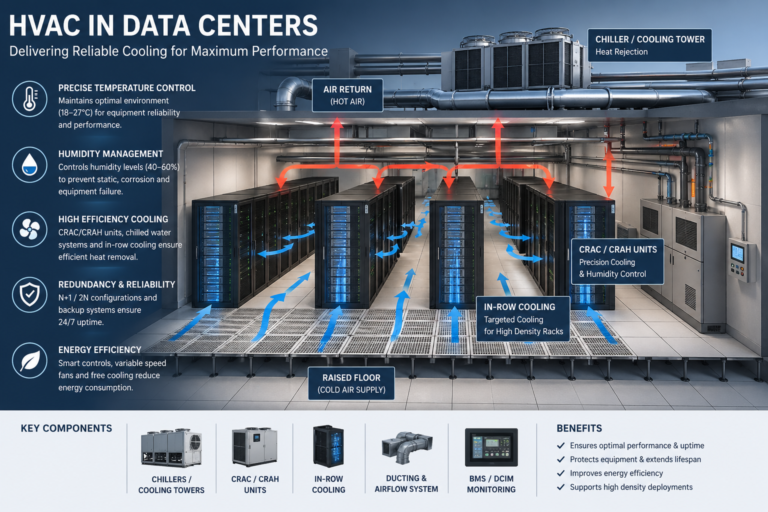
Hydraulic design — sizing pipes correctly for flow velocity, pressure drop, and system balance — is where most MEP contractors under-invest. In a data centre, poorly designed hydraulics manifest as:
Recommended Flow Velocities for Chilled Water Systems
Three Hydraulic Design Rules That Cannot Be Compromised |
|
|
|
India’s climate makes HVAC pipe insulation a safety issue, not just an energy issue. Chilled water pipes operating at 6°C–12°C in an environment with ambient temperatures of 35°C and relative humidity of 60–85% will experience severe surface condensation if underinsulated. This leads to:
Insulation Thickness Guidelines for Indian Climate (Mumbai / Bangalore / Hyderabad)
Pipe Diameter | Chilled Water (6°C) | Secondary CHW (12°C) | Material |
DN 15 – DN 40 | 25 mm | 19 mm | Closed-cell Elastomeric |
DN 50 – DN 100 | 32 mm | 25 mm | Closed-cell Elastomeric or PU Foam |
DN 125 – DN 200 | 40 mm | 32 mm | PU Foam with GI cladding |
DN 250 and above | 50 mm | 40 mm | PU Foam / Mineral Wool with GI cladding |
Never use fibreglass wool insulation on chilled water pipes in humid Indian climates. Fibreglass is moisture-permeable — once condensation penetrates the insulation jacket, it becomes waterlogged, loses all thermal resistance, and promotes pipe corrosion. Specify closed-cell elastomeric foam (Armaflex or equivalent) for all sub-ambient piping.
Redundancy in the piping system is not optional for Tier III and Tier IV data centres — it is a certification requirement. Yet redundancy is often misunderstood as “having a spare chiller.” True redundancy means the entire piping path from chiller to CRAH must be independently operable.
What N+1 Means in Piping Terms
What 2N Means in Piping Terms (Tier IV)
After executing MEP works across multiple data centres and industrial facilities, SRJ Group has identified the following as the most recurring and costly field mistakes:
7 Mistakes That Cause Data Centre HVAC Piping Failures in India |
|
|
|
|
|
|
|
Commissioning of HVAC piping in a data centre is a structured, documented process — not a site walk-through. The following tests and documentation are required before any data centre facility goes live:
Pressure Testing
Chemical Flushing and Fill
Hydraulic Balancing
Documentation Handover Package
Q: Should chilled water pipes in a data centre be black steel or stainless steel?
Black carbon steel is the industry standard for primary chilled water mains in India due to its cost advantage and availability. Stainless steel (SS304 or SS316L) is used for secondary loops in high-purity applications or where the client mandates it. The key is not the material choice but the water treatment programme — carbon steel in a well-treated closed loop lasts 30+ years.
Q: How do I size the expansion vessel for a chilled water system?
Expansion vessel sizing is based on system water volume, operating temperature range, and pre-charge pressure. For chilled water systems (6°C to ambient), the volume variation is small but the vessel must accommodate pump surge. As a rule of thumb, the expansion vessel capacity should be approximately 4–6% of total system water volume for a closed chilled water loop. Always verify against the chiller manufacturer’s minimum flow and maximum pressure specifications.
Q: What is the correct approach to noise and vibration isolation for chilled water pumps?
Vibration transmission from chilled water pumps to the building structure — and ultimately to sensitive IT equipment — is a real concern in data centres. Specify: (1) inertia base frames for all primary pumps; (2) flexible rubber-bellows connections on pump suction and discharge; (3) spring isolators under pump baseframes sized for the operational RPM; and (4) acoustic lagging on pump discharge pipes within 3 metres of the pump.
Q: What flow velocity should I use for preliminary pipe sizing?
For preliminary sizing of carbon steel chilled water mains in data centres, use 1.5–2.0 m/s as a starting velocity. This balances pipe size (and cost) against pressure drop (and pump energy). Final sizing must be confirmed by detailed hydraulic calculations. Never use more than 3.0 m/s in any section — above this threshold, erosion of pipe walls and fittings accelerates significantly.
Conclusion: Get the Piping Right Before the IT Goes In
HVAC piping in a data centre is not a line item to value-engineer. The decisions made in design and installation — material selection, hydraulic balance, insulation specification, redundancy topology — determine the facility’s operational reliability for the next 15–25 years.
For Indian data centre developers and EPC contractors, the critical success factors are: strict adherence to IS codes plus international best practices, a chemical water treatment programme from day one, proper hydraulic modelling, and a structured commissioning process before any IT load is connected.
SRJ Group has been executing precision MEP and industrial piping works across Bangalore and India since 1985. Our teams have delivered HVAC piping systems for data centres, pharmaceutical plants, manufacturing facilities, and commercial complexes — with an unbroken record of on-spec, on-schedule delivery.
Planning a Data Centre HVAC Piping Project? Talk to SRJ Group’s MEP engineering team for a no-obligation technical consultation. We cover full MEP + piping + fire protection — single vendor, end to end. srjpipingindia.com | info@srjpiping.com | Bangalore |
Tags: HVAC Piping • Data Centre MEP • Chilled Water Piping • MEP Contractor Bangalore • Industrial Piping India • Data Centre Cooling • ASHRAE TC 9.9 • Uptime Institute • MEP Standards India
Related: Fire Protection Systems for Data Centres | MEP Contractors in Bangalore | Industrial Piping Services | Process Piping vs Utility Piping
SRJ Piping India is your trusted partner. Give us a call for a free consultation