
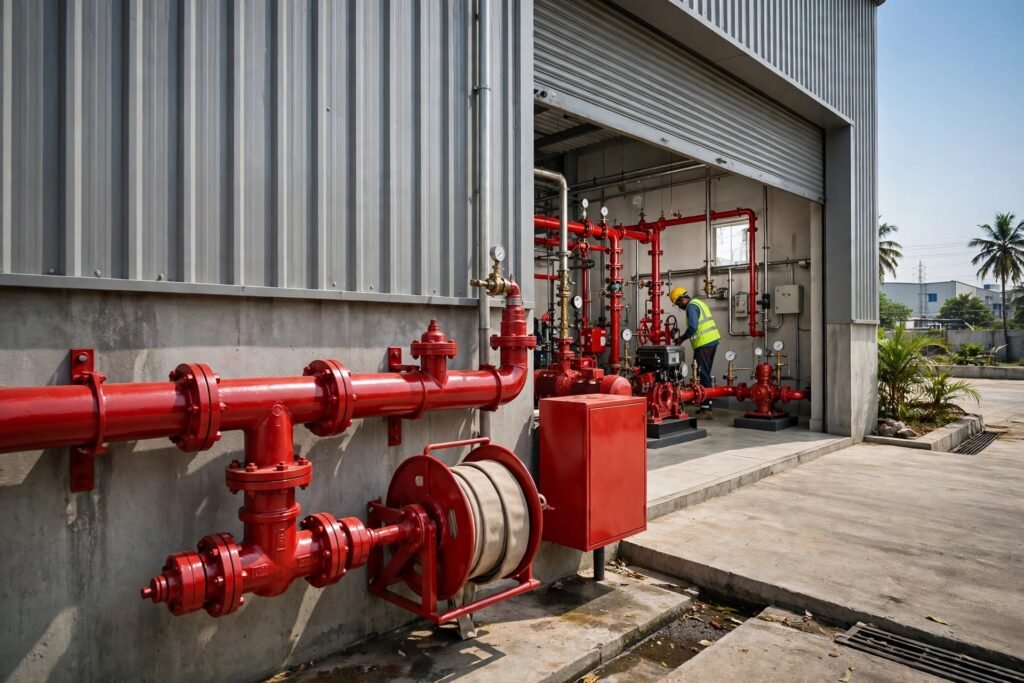
If you are building or expanding a factory or warehouse in Bengaluru or elsewhere in Karnataka, the fire hydrant system is usually one of the largest pieces of the fire fighting system: a dedicated water tank, a fire pump room, a buried or above-ground ring main and hydrant posts around the buildings. It is also one of the items a fire officer looks at closely before a Fire NOC.
This guide explains what a hydrant system is, which standards apply, what the main design rules in IS 13039 say, and the questions to ask before you award the work. It is general guidance, not a design. Your fire consultant and the Karnataka State Fire and Emergency Services decide what applies to your site.
What a fire hydrant system includes
A hydrant system is a fixed, pressurised water network that firefighters and trained staff connect hoses to. A typical industrial system has:
- Dedicated water storage reserved for fire fighting only
- A fire pump room with main pumps, a diesel standby pump and a jockey pump
- Hydrant mains, normally laid as a ring so water can reach any hydrant from two directions
- Yard hydrants (stand posts with landing valves) outside the buildings, and, for taller buildings, wet risers with landing valves on each floor
- Hose boxes with hoses, branch pipes and nozzles near the hydrants
- Valves, gauges and alarms so the system can be isolated, monitored and tested
Hydrants are different from sprinklers. A sprinkler system works automatically over the fire. A hydrant system needs people to run hoses to the fire. Many factories need both; see our guide to how fire sprinkler systems work.
Which standards apply: NBC 2016 and IS 13039
Two documents come up on almost every industrial hydrant project in India:
- National Building Code of India 2016, Part 4 (Fire and Life Safety). Table 7 lists the minimum fire fighting installations by occupancy, including yard hydrants, wet risers, water storage and pump capacity. Note 17 of the table matters for industry: the Group G (industrial) values are for small-scale industry units. For other industries, the requirements are to be worked out from the relevant Indian Standards in consultation with the local fire authority.
- IS 13039:2014, External Hydrant Systems: Provision and Maintenance. This BIS code covers hydrant systems for medium and large industrial risks. Petroleum refining and petrochemical plants are excluded; those follow OISD standards.
Related standards referenced by IS 13039 include IS 908 (stand post hydrants), IS 5290 (landing valves), IS 12469 (fire pumps), IS 636 (fire hoses) and IS 1239 / IS 3589 (steel pipes).
In Karnataka, the Fire NOC process is handled by the Karnataka State Fire and Emergency Services. We explain recent changes in our article on Karnataka Fire NOC rules.
Step 1: Hazard class decides your hydrant system size
IS 13039 sizes water storage and fire pump capacity by occupancy hazard class (light, ordinary and high hazard, set out in its Annex B), not just by floor area. The same building can need a very different system when it stores plastics, solvents or packed goods instead of light assembly work.
Get the hazard class agreed early with your fire consultant. A wrong assumption here changes tank size, pump size and pipe sizes later.
Step 2: Fire water storage for the hydrant system
IS 13039 requires static storage reserved for the hydrant service, sized as hours of aggregate pumping capacity. For light hazard, it is not less than 1 hour of pumping capacity with a minimum of 135,000 litres. The required duration increases for ordinary and high hazard occupancies.
Practical points:
- Keep fire water separate from process or domestic water, or draw general water from a higher level so the fire reserve cannot be used up.
- Plan the tank in compartments so one can be cleaned while the other stays in service. The code allows only one compartment to be emptied at a time.
Step 3: Fire pump room: main, diesel and jockey pumps
Key IS 13039 requirements for the fire pump arrangement:
- Fire pumps conforming to IS 12469, used only for fire fighting, and direct-coupled (belt drives are not accepted).
- If the main pumps are electric, a diesel engine-driven standby pump of similar capacity. Where there are two or more main pumps, standby pumps equal half the number of main pumps.
- Jockey pumps to make up small system losses and reduce surges, generally sized at 3–5% of installed pumping capacity, with a minimum of 10.8 m³/h.
- Positive suction, automatic starting with sequential start, and an audible alarm.
- A non-return valve, sluice valve and pressure gauge on each pump delivery.
- Pump room construction and separation from other buildings as specified in the code.
The diesel pump needs fuel, a battery system and a daily test run; IS 13039 calls for the engine to be run for at least 5 minutes each day.
Step 4: Hydrant ring main and hydrant layout
This is the piping part of the job, and it is where workmanship shows up years later.
- Ring mains. Mains are laid in rings, except where the code allows otherwise.
- Pressure at the far end. The system must be hydraulically designed so that, with half the pumping capacity discharging at the most remote hydrant and half in the most vulnerable area on the way, the running pressure at the remote point is at least 5.25 kg/cm² and velocity does not exceed 5 m/s.
- Underground mains have the top of pipe at least 1 m below ground, with supports suited to the soil, and a protective coating and wrapping for buried steel.
- Above-ground mains are medium-grade steel pipe (IS 1239 or IS 3589), supported on masonry or RCC pedestals, not on pipe racks.
- Hydraulic test. The system must withstand 150% of the maximum working pressure for 2 hours.
Hydrant positions:
- At least one hydrant for every 60 m of external wall for light hazard, every 45 m for ordinary hazard and every 30 m for high hazard.
- Where part of a building is used for storage or hazardous processes, two single or one double-headed hydrant within 15 m of the building.
- Hydrant outlets about 1 m above ground, kept clear of storage, protected from vehicles, and serially numbered.
Step 5: Testing, handover and maintenance
Before handover, flush the system, do the hydraulic test and a flow test, and collect as-built drawings, test records and pump curves. Our MEP testing, commissioning and handover checklist covers the documents to ask for.
After handover, IS 13039 sets routine checks, including:
- Weekly: examine every hydrant’s valves and spring catches.
- Fortnightly: test the hydrant mains with a pump at maximum pressure, with a running test on at least two 30 m hose lines.
- Monthly: operate and, if needed, oil all cut-off valves; overhaul them annually.
Use these alongside our fire safety audit checklist for factories and warehouses in Bangalore.
Questions to ask before awarding hydrant work
- Which hazard class has the design assumed, and who agreed it?
- Has the system been hydraulically calculated to the remote-point pressure in IS 13039? Can we see the calculation?
- Which pipe standard, grade, coating and wrapping will be used for buried mains?
- Are the pumps, hydrants, landing valves and hoses to the relevant IS standards, with test certificates?
- Who prepares the drawings for the Fire NOC, and who attends the fire department inspection?
- What tests will be done at handover, and in what format will records be given?
- Does the contract include training your staff to run the pumps and hoses?
Frequently asked questions
Not always. It depends on occupancy, hazard, area and height. NBC 2016 Table 7 gives minimums for small-scale industry units; for other industries, requirements are worked out from Indian Standards such as IS 13039 with the local fire authority.
Sprinklers operate automatically over a fire. Hydrants supply pressurised water that people use through hoses. Many industrial buildings need both.
It keeps the hydrant mains pressurised by making up small leaks, so the main fire pumps do not start for minor pressure drops. IS 13039 generally sizes it at 3–5% of installed pumping capacity.
So the system still works during a power failure. IS 13039 requires a diesel standby pump where the main pumps are electric.
IS 13039 requires the system to withstand 150% of maximum working pressure for 2 hours, plus flushing and flow testing before commissioning.
IS 13039 calls for weekly hydrant checks, fortnightly tests of the mains and monthly operation of cut-off valves, with an annual valve overhaul.
The Karnataka State Fire and Emergency Services (KSFES) reviews the fire-fighting scheme, including the hydrant system, as part of the Fire NOC. After the system is installed, the department inspects the as-built work before clearance. We explain the stages in our article on Karnataka Fire NOC rules. Confirm the current documents and process with KSFES for your project.
Talk to SRJ Group
Since 1985, SRJ Group has delivered piping and fire protection work for industrial clients. Our fire protection systems team designs, installs and commissions hydrant networks, fire pumps and related systems. If you are planning a fire hydrant system for a factory or warehouse in Karnataka, contact us with your drawings and we will review the scope with you.