
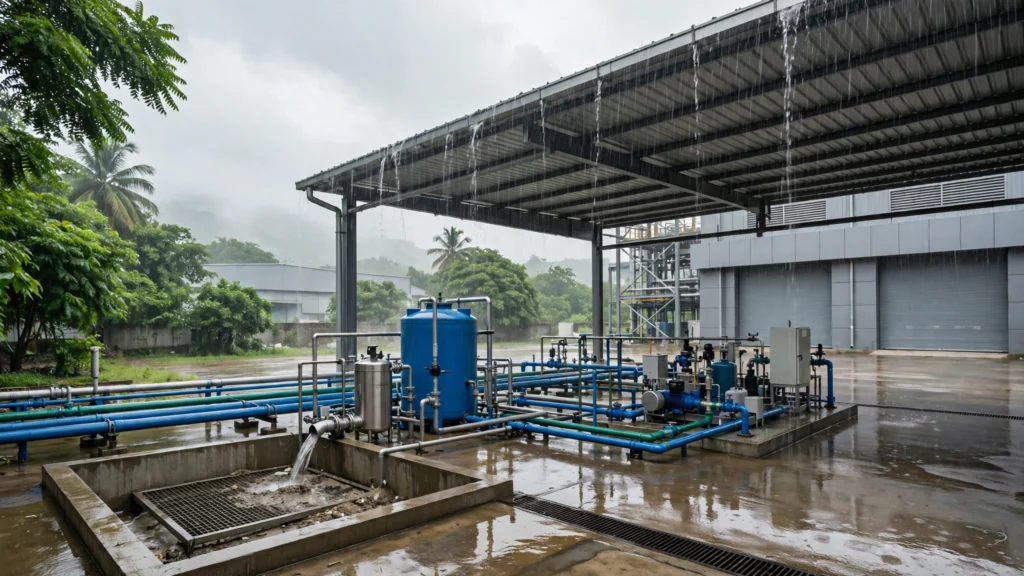
A factory or warehouse roof is one of the largest water catchments a business owns. In Bengaluru, rainwater harvesting for factories is also a legal requirement for most sites. Many industrial systems are built only to get the plan approved and are not maintained afterwards. Others feed rainwater from an oily yard straight into a borewell. This guide explains what the rules require, how to size a system for a large industrial roof, and what to check before you ask for quotes.
This article is general guidance, not legal advice. Rules and capacity norms change, so confirm current requirements with BWSSB, the Karnataka Ground Water Authority or your local planning authority before you finalise a design.
Is rainwater harvesting mandatory for factories in Bengaluru?
For most sites within the Bangalore Water Supply and Sewerage Board (BWSSB) area, yes. Section 72A of the Bangalore Water Supply and Sewerage Act, 1964, as substituted by the BWSSB (Amendment) Act, 2021 (Karnataka Act 29 of 2021), sets out three tiers:
| Site (sital) area | What Section 72A requires |
|---|---|
| New building on 108 sq m or more | A rainwater harvesting structure for storage, for use or for groundwater recharge |
| Existing building on 216 to 1,000 sq m without RWH | A rainwater harvesting structure for storage, use and groundwater recharge |
| New or existing building on 1,000 sq m or more without RWH | A dual piping system plus rainwater harvesting for storage and use (other than drinking, cooking and bathing) based on roof area, and groundwater recharge based on paved and unpaved areas |
Most factories and warehouses fall in the top tier, at 1,000 sq m (about 10,764 sq ft) or more. In that tier, a recharge pit on its own does not meet the rule. The law expects you to store and use roof water through a separate non-potable piping network, and to recharge from the paved and open areas.
The BWSSB levies penalties through the water bill when a property does not comply. The rates have changed over the years, so check the current figures with BWSSB rather than relying on old news reports.
Outside the BWSSB area: KIADB estates and other towns
Many factories in Karnataka sit outside BWSSB limits, for example in KIADB industrial areas or in other districts. In those places, the Karnataka Ground Water Act, 2011 matters most:
- In areas notified under the Act, anyone drilling or digging a well needs a permit from the Karnataka Ground Water Authority (KGWA). The Act says permit conditions “shall include mandatory provision of artificial recharge structures of appropriate size” (Section 11(3)).
- In urban parts of notified areas, Section 22 allows the KGWA to direct rainwater harvesting for residential, commercial and other premises of 100 sq m or more. Local authorities may make rooftop rainwater harvesting a condition of building plan approval, and permanent water and power connections can be held back until it is in place.
Karnataka regulates groundwater through its own authority, so industrial groundwater NOCs here come from the Karnataka Ground Water Authority (KGWA), not the Central Ground Water Authority (CGWA). The CGWA’s 2020 groundwater guidelines still say they apply across India, and they are a useful benchmark. Your planning authority, industrial estate or KGWA permit may add conditions of its own, so read your sanctioned plan and permit carefully.
How much rainwater harvesting capacity does a factory need?
Capacity rules differ between the regulations, so check this first.
- BWSSB guideline and the 2010 regulations: the BWSSB rainwater harvesting guideline hosted by KSCST sets a minimum of 20 litres per sq m of roof area and 10 litres per sq m of paved open space. The BWSSB Rain Water Harvesting Regulations, 2010, use the same 20 L/sq m roof figure, and 10 L/sq m of land for land-based harvesting.
- Later guidance: in a 2021 report in The Hindu, a groundwater expert said the roof-area requirement had been raised to 60 litres per sq m. We could not confirm the current figure from an official BWSSB document, so ask BWSSB or your architect which norm your sanction follows.
To see how much these norms differ, take a warehouse with a 5,000 sq m roof:
- At 20 L/sq m: 5,000 × 20 = 100,000 litres (100 m³) of storage or recharge capacity
- At 60 L/sq m: 5,000 × 60 = 300,000 litres (300 m³)
That difference changes the civil works, the space you need and the budget, so settle it before design starts. The 5,000 sq m figures are illustrative arithmetic, not a site-specific design.
How much water can the roof actually collect?
The statutory capacity is a minimum. Your actual design depends on how much water the roof yields and how much the plant can use. IS 15797:2008 (Roof top rainwater harvesting – Guidelines, BIS) gives the basic method:
Runoff (litres) = roof area (sq m) × rainfall (mm) × runoff coefficient
IS 15797 puts the runoff coefficient between 0.8 and 0.95, depending on the roof type. On the same 5,000 sq m roof, with an assumed coefficient of 0.85, a single 10 mm shower gives about 42,500 litres. A heavy monsoon day gives several times that. Industrial roofs collect a lot of water in a short time, so gutters, downtake pipes and filters need to be sized for the peak flow as well as for the total volume.
Design checklist for a large industrial roof
1. Gutters and downtake pipes
Long metal-sheet roofs on pre-engineered and conventional steel buildings shed water fast. Gutter sections, outlet spacing and downtake pipe sizes should come from a hydraulic calculation, not a rule of thumb. If the gutters are too small they overflow at the eaves, and the system collects far less than the drawings suggest. Plan the routing of downtake pipes along the columns early, so they don’t clash with doors, racking, cable trays or crane runways.
2. First flush and filtration
IS 15797 recommends throwing away the first runoff from a roof, because it carries most of the dust, leaves and bird droppings. Use a first-flush diverter or a valve at the foot of the downpipe, followed by screens and a filter or filter chamber sized for the peak flow. On large roofs, a filter pit or chamber usually works better than small inline filters.
3. Storage sump and dual piping
On sites of 1,000 sq m or more in the BWSSB area, roof water has to be stored and used. In practice that means:
- An underground sump or surface tank, with the overflow routed to recharge structures or the storm drain
- A separate, clearly marked non-potable network (the “dual piping”) feeding uses such as toilet flushing, landscaping and floor washing. This network is usually designed as part of the plant’s plumbing and MEP systems package
- A make-up connection from the main supply, with an air gap or backflow protection, so rainwater can never flow back into the potable line
- If the plant wants to use rainwater for process or utility make-up, such as cooling towers or boiler feed, check the treatment needed first. The BWSSB Rain Water Harvesting Regulations, 2010, say rainwater used for drinking must be treated to IS 10500 standards. Process water has its own quality requirements, which may call for filtration, softening or reverse osmosis.
4. Groundwater recharge, done safely
The recharge part of the system takes runoff from paved and unpaved areas and any overflow from storage. Points to watch:
- Never send roof or yard water straight into a working borewell. The BWSSB guideline hosted by KSCST says rainwater from the roof, even after a filter, should not go directly into a live borewell, and that a skilled person’s advice is needed first. The BWSSB Rain Water Harvesting Regulations, 2010, also require filtered water to be stored and settled in a sedimentation tank before any borewell recharge.
- Keep yard runoff clean. Loading bays, truck parking and drum storage areas can carry oil, diesel and chemicals. Keep these areas out of the recharge system, or pass their runoff through suitable separation first.
- Polluting industries should store rather than recharge. The CGWA’s 2020 guidelines say industries likely to pollute groundwater, such as chemical, pharmaceutical, dyes, paints, textiles and tanneries, “shall store the harvested rain water in surface storage tanks for use in the industry”. Even where the KGWA, not the CGWA, issues your permit, this is sound practice.
- Check the ground. IS 15797 describes recharge pits, trenches, dug wells and recharge wells. The right choice depends on soil, rock depth and water table, so get a hydrogeological opinion for large systems.
- Keep recharge away from STP and ETP areas, fuel storage and soak pits.
5. Access and maintenance
IS 15797 recommends checking the catchment, gutters, screens, first flush and overflow before and after rains, and cleaning the storage tank of sediment before the monsoon. For a factory, that means:
- Safe roof access and walkways, so gutters can be cleaned without walking on fragile sheeting
- Inspection chambers and manholes at filters and sumps
- A simple pre-monsoon checklist written into the facility maintenance plan
Bengaluru gets rain from both the southwest and northeast monsoons. Schedule the main clean-out before June and check again before October.
Common mistakes in rainwater harvesting for factories
- Building only recharge pits on a site of 1,000 sq m or more. In the BWSSB area, the 2021 amendment requires storage, use and dual piping on these sites.
- Using the old 20 L/sq m figure without checking. Confirm the norm your sanction follows. The 2010 regulations and the KSCST-hosted guideline use 20 L/sq m of roof; later reports have cited 60 L/sq m, which we could not confirm from an official BWSSB source.
- Leaving the system out of the MEP scope. Rainwater piping falls between civil, plumbing and roofing packages. Name it in the MEP scope of work so one party owns it.
- Mixing rainwater with treated sewage or effluent. Keep harvested rainwater separate from STP and ETP outlets, which have their own treatment and discharge rules. See our explainer on STP vs ETP vs WTP.
- No maintenance owner. Choked gutters and silted filters can leave a compliant system collecting little water within a couple of seasons.
What to prepare before asking for a rainwater harvesting system proposal
- Site plan with roof, paved and unpaved areas in sq m
- Roof type (metal sheet, RCC) and drawings showing gutters and existing downtakes
- Whether the site is in the BWSSB area, a KIADB estate or elsewhere, and any conditions in the sanctioned plan or KGWA permit
- Daily non-potable water demand (flushing, landscaping, washing, utility make-up)
- Locations of borewells, open wells, the STP or ETP, fuel and chemical storage
- Space available for sumps, filters and recharge structures
- Your intended use: compliance only, or real reduction in tanker or BWSSB water
Frequently asked questions
In the BWSSB area of Bengaluru, Section 72A of the BWSSB Act applies to sites from 108 sq m upwards, and sites of 1,000 sq m or more need dual piping. Elsewhere in Karnataka, it depends on local building rules and on whether the area is notified under the Karnataka Ground Water Act, 2011. KGWA permits must include artificial recharge conditions. Check your sanctioned plan and permit.
For sites of 1,000 sq m or more, the 2021 amendment requires a dual piping system: a separate network that supplies harvested rainwater for uses other than drinking, cooking and bathing, alongside the normal potable supply.
Multiply the roof area in sq m by the applicable BWSSB norm. The 2010 regulations and the KSCST-hosted guideline say 20 litres or more per sq m of roof, and later guidance has reportedly raised this to 60 litres per sq m, so confirm the current figure with BWSSB. To estimate how much water the roof yields, use roof area × rainfall (mm) × runoff coefficient. IS 15797 gives the coefficient as 0.8 to 0.95.
Often, yes, once it has been treated to suit the use. Rainwater is generally suitable for flushing, landscaping and washing after filtration. Process, cooling tower or boiler make-up water needs a quality check, and may need softening, RO or other treatment. Water for drinking must meet IS 10500.
Not directly. The BWSSB guideline hosted by KSCST says filtered roof water should not go straight into a live borewell, and that a skilled person’s advice is needed first. The BWSSB Rain Water Harvesting Regulations, 2010, also require filtering, storage and settling in a sedimentation tank before borewell recharge. Industries likely to pollute groundwater should store harvested rainwater in surface tanks for use rather than recharge it, as the CGWA’s 2020 guidelines say.
No. Karnataka has its own Ground Water Authority (KGWA), which issues industrial groundwater permits in the state. Check with the KGWA whether your area is notified and what permit your borewells need.
IS 15797 recommends checking gutters, screens, the first flush and overflows before and after rains, and cleaning the storage tank before the monsoon. Bengaluru has two monsoons, so plan inspections before June and October at the least.
Talk to SRJ Group
Since 1985, SRJ Group has delivered industrial piping and water treatment plant work for factories. Our water treatment work includes rooftop rainwater collection, screening and silt traps, intake pumping, filtration, softening and RO, as part of plant design, installation and maintenance. If you are planning rainwater harvesting for a factory or warehouse in Bengaluru, contact us with your site plan and roof drawings, and we can discuss how harvested water could connect to your plant’s water system.
Sources
- Bangalore Water Supply and Sewerage (Amendment) Act, 2021 (Karnataka Act 29 of 2021), substituting Section 72A, Karnataka Gazette, 7 Oct 2021: https://uncomplycate.com/wp-content/uploads/2021/10/3.-Karnataka_Bangalore-Water-Supply-and-Sewerage-Amendment-Act-2021.pdf (copy of the gazette notification hosted on a third-party site)
- BWSSB (Amendment) Act, 2009 and BWSSB rainwater harvesting guideline (KSCST): https://www.kscst.org.in/rwh_files/pdf/BWSSB_RWH_Act.pdf (working copy used for the 20 L/sq m roof and 10 L/sq m paved-open-space figures, and for the advice not to feed filtered roof water directly into a live borewell)
- Bangalore Water Supply and Sewerage (Rain Water Harvesting) Regulations, 2010. Cited in the article for the same 20 L/sq m roof figure, for treatment of drinking water to IS 10500, and for storage and settling in a sedimentation tank before borewell recharge. The India Code file timed out when checked on 15 Nov 2026 and has been omitted as a live link.
- The Karnataka Ground Water (Regulation and Control of Development and Management) Act, 2011 (PRS India): https://prsindia.org/files/bills_acts/acts_states/karnataka/2011/2011KR25.pdf
- Karnataka Ground Water Authority application portal: https://www.kgwa.in/public/
- CGWA Guidelines to regulate and control ground water extraction in India, S.O. 3289(E), 24 Sep 2020 (copy hosted by MPCB): https://mpcb.gov.in/sites/default/files/water-quality/standards-protocols/Ground_Water_NewGuidelinesNotifiedeng24092021102020.pdf
- IS 15797:2008, Roof top rainwater harvesting – Guidelines (BIS; Public.Resource.Org copy): https://law.resource.org/pub/in/bis/S14/is.15797.2008.pdf
- The Hindu, “BWSSB tweaks law to make RWH must for 30×40 sites”, 19 Nov 2021: https://www.thehindu.com/news/cities/bangalore/bwssb-law-tweaked-to-make-rwh-must-for-30×40-sites/article36505675.ece