
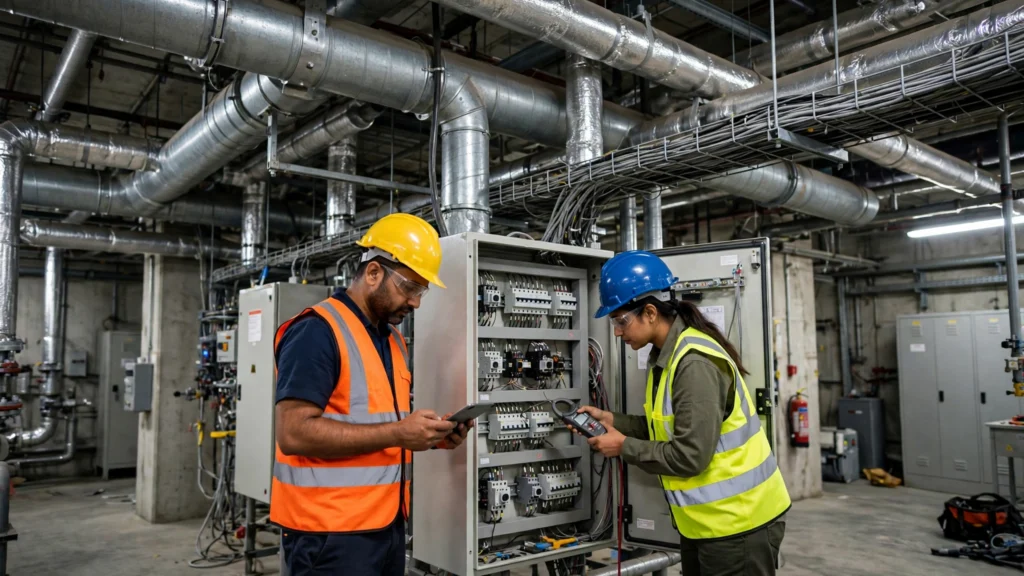
The building is up, the panels are energised for trials and the move-in date is close. This is when many factory owners in Bengaluru and across Karnataka find out how well their MEP (mechanical, electrical and plumbing) works were actually delivered. MEP testing and commissioning is the stage where every service is proved to work as designed, alone and together, before you sign the handover and the defects-liability clock starts.
This guide is for owners, plant heads and project managers. It explains what to ask for, which Karnataka sign-offs sit alongside commissioning, and which documents to collect before you accept the keys.
What testing and commissioning actually means
The three terms are often used as if they mean the same thing, but they don’t:
- Testing checks that one item or section is installed correctly. Examples are a pressure test on a pipe run, an insulation-resistance test on a cable or a duct leakage test.
- Commissioning proves that whole systems run as designed, under real operating conditions. The chiller holds set-point, the DG set picks up load on mains failure, and the pumps deliver design flow and head.
- Handover is the formal transfer of the commissioned systems, with records, drawings, manuals and trained staff, from the contractor to you.
International practice treats commissioning as a quality process that runs through the whole project, not as a last-week activity. ASHRAE Guideline 0 (The Commissioning Process) describes it as verifying that a facility and its systems meet the Owner’s Project Requirements (OPR). In practice, that means writing down early what you need the building to do: capacities, redundancy, temperatures, power quality and maintainability. Commissioning then tests against that list.
In India, NBC 2016 Part 7 states that all mechanical, electrical and plumbing services shall be installed as per approved designs under Part 8 (Building Services) and Part 9 (Plumbing Services). Testing and commissioning is how you show that this happened.
Put commissioning into the MEP contract, not just the programme
Most handover disputes start with a vague contract. Before work begins, make sure your MEP contractor‘s scope or tender clearly covers:
- Method statements for testing and commissioning for each system, submitted and approved before installation is complete.
- Witness and hold points. These are the tests your engineer or consultant must witness, such as pipe pressure tests before insulation or concealment.
- Calibrated instruments. Every test instrument should have a valid calibration certificate.
- OEM start-up. Major equipment such as chillers, DG sets, transformers, VFDs and fire pumps should have OEM start-up reports where the manufacturer requires them for warranty.
- Who provides what during commissioning. This covers power, water, fuel, consumables and temporary loads. Agree it up front so it doesn’t turn into a dispute later.
- Integrated systems testing. Test how the systems work together, not just one at a time.
- Handover deliverables. List the documents you expect, as a schedule in the contract (see the table below).
- Training and the defects-liability period. Agree the start date and the response obligations.
Karnataka sign-offs that sit alongside MEP commissioning
Statutory approvals are not the same as commissioning. An installation can be approved and still perform poorly. You need both. Which approvals apply depends on your supply voltage, building height, occupancy and equipment, so confirm the exact list with your consultant and the authorities.
Electrical installations
Under the Central Electricity Authority (Measures relating to Safety and Electric Supply) Regulations, 2023, regulation 45 sets two routes:
- Installations at or below the voltage notified by the State Government must be inspected, tested and self-certified by the owner, supplier or consumer before supply starts. The self-certification report goes to the Electrical Inspector.
- Installations above the notified voltage must be inspected and tested by the Electrical Inspector, who must give written approval before they are energised.
In Karnataka, the Department of Electrical Inspectorate handles approval of drawings and approval of installations. It currently lists its online services through the state’s Seva Sindhu portal. The Karnataka Electricity Regulatory Commission’s Conditions of Supply also require the applicant to give the distribution licensee (your ESCOM, such as BESCOM in Bengaluru) the electrical contractor’s completion and test report. HT/EHT installations need approval from the Electrical Inspectorate before the licensee tests and connects them.
Practical point: Build to the approved drawings. If the installation changes during construction, sort out the drawing revision before inspection, not after.
Lifts and goods lifts
If your factory has a passenger or goods lift, the Karnataka Lifts, Escalators and Passenger Conveyors Act, 2012 requires a licence before the lift is used. Before the licence, electricity may be supplied to the lift only for testing. The application goes to the Department of Electrical Inspectorate with the erector’s completion report and test certificates. Plan for this in your move-in date.
Fire protection
Fire hydrant, sprinkler, detection and alarm systems have their own acceptance tests and fire-department requirements. For Karnataka’s approval framework, see our guide to Karnataka Fire NOC rules. For ongoing compliance after handover, see our fire safety audit checklist for factories and warehouses.
MEP testing and commissioning checklist by system
These are typical checks. Your specification, the OEM requirements and the applicable IS codes decide the exact tests and acceptance values. Ask for each result in writing, signed and dated.
Electrical: HT/LT panels, cabling, earthing and DG sets
- Insulation-resistance tests on cables, busbars and motors, recorded circuit by circuit.
- Earth-electrode and earth-continuity tests. IS 3043 is the Indian code of practice for earthing.
- Breaker and relay settings checked against the approved protection coordination.
- RCD/RCCB trip tests, phase sequence and polarity checks.
- Transformer pre-commissioning tests and OEM reports.
- DG set load test, plus auto mains failure (AMF) changeover under real load.
- Wiring checked against the code of practice for electrical wiring installations (IS 732) and the approved drawings.
HVAC and ventilation
- Pressure testing and flushing of chilled-water and condenser-water piping before equipment is connected.
- Duct leakage checks on critical runs.
- Testing, adjusting and balancing (TAB): measured air and water flows at every terminal, compared with design.
- Chiller, AHU and cooling-tower start-up by the OEM.
- Controls/BMS point-to-point checks: every sensor, actuator and alarm verified, not sampled.
- Ventilation rates in plant rooms, battery rooms, kitchens and toilets checked against design.
Plumbing, drainage and water systems
- Hydraulic pressure test on water supply lines before concealment.
- Flushing and disinfection of potable-water lines, with water quality reports where specified.
- Drainage tests for leaks and flow, checked at inspection chambers.
- Pump sets: duty/standby changeover, level controls, dry-run protection.
- Water from your treatment plant (where there is one) commissioned and recorded. Our STP vs ETP vs WTP guide explains which plant does what.
Utility and process piping: compressed air, gases and steam
- Pressure or leak test as per the design code and specification, at the stated test medium and duration.
- Line cleaning or blowing before equipment is connected.
- Line identification, colour coding and flow-direction marking.
- Safety valves, regulators and isolation valves checked and tagged.
For more on inspection and documentation of piping work, see piping QA/QC standards and best practices.
Integrated systems test: the one most often skipped
Individual systems can pass on their own and still fail together. Run at least one planned power-failure test and record what happens:
- The DG set starts and picks up the essential loads within the design time.
- Essential pumps, emergency lighting and critical HVAC restart in the right sequence.
- Fire alarm signals trigger the designed actions, such as AHU shutdown or damper operation, wherever the design calls for them.
- When mains power returns, systems change back cleanly with no nuisance trips.
Handover documents to demand
| Document | Why it matters |
|---|---|
| As-built drawings (editable CAD and PDF) | Future maintenance, expansions and audits depend on them |
| Test and commissioning reports, signed | Proof that each system met its acceptance criteria |
| Statutory approvals and certificates | Electrical, lift and fire approvals, as applicable |
| OEM start-up reports and warranty certificates | Warranties can depend on correct start-up |
| O&M manuals and spare-parts lists | Your maintenance team’s reference |
| Instrument calibration certificates | Shows the test results can be trusted |
| Protection settings and panel schedules | Needed for safe fault-finding and future load additions |
| Training records | Evidence that your operators were trained on each system |
| Snag list with close-out sign-off | Shows what was outstanding and when it was fixed |
NBC 2016 has a separate part on Asset and Facility Management (Part 12). Good handover records are the starting point for it.
Common gaps at MEP handover
- “Tested” with no records. If there is no signed test sheet, assume the test wasn’t done.
- As-builts that are just the tender drawings. Check a few routes on site against the drawings.
- Balancing skipped because “the AC is cooling.” Unbalanced systems waste energy and leave hot spots.
- No integrated test. The first real power cut becomes the test.
- Training done in one rushed session with people who won’t actually run the plant.
- Snags carried into occupancy with no dates or owners.
Quick MEP handover checklist
- ✓ Owner’s Project Requirements agreed and written down
- ✓ T&C method statements approved
- ✓ Witnessed pressure tests completed before concealment
- ✓ Electrical self-certification or Electrical Inspectorate approval in place, as applicable
- ✓ Lift licence obtained (if lifts are installed)
- ✓ Fire systems tested and approvals in place, as applicable
- ✓ TAB report received for HVAC
- ✓ Integrated power-failure test witnessed and recorded
- ✓ As-built drawings, O&M manuals, warranties and calibration certificates received
- ✓ Operators trained; snag list closed or dated
FAQs
What is MEP testing and commissioning?
It is the process of testing each mechanical, electrical and plumbing installation and then proving that complete systems work as designed, alone and together, before the building is handed over to the owner.
What is the difference between pre-commissioning and commissioning?
Pre-commissioning covers static and dead checks, such as pressure tests, insulation-resistance tests, flushing and cleaning, before systems run. Commissioning is the live stage: starting systems, setting and balancing them, and proving performance under load.
Who is responsible for testing and commissioning?
Usually the MEP contractor carries out the tests. The owner’s consultant or engineer witnesses and accepts them, and OEMs handle start-up of major equipment. The exact split should be written into your contract.
Does every factory in Karnataka need Electrical Inspectorate approval?
Not necessarily in the same form. Under the CEA Regulations, 2023, installations at or below the state’s notified voltage are self-certified by the owner, with the report sent to the Electrical Inspector. Installations above it need inspection and written approval by the Electrical Inspector before energisation. Check your installation’s category with your electrical consultant or the Department of Electrical Inspectorate.
How long does MEP commissioning take?
It depends on the size of the facility, the number of systems and how ready the site is, so there’s no standard figure. Allow time in the programme for testing, rectification, retesting and statutory inspections, rather than squeezing commissioning into the last few days.
Why insist on as-built drawings in editable format?
Every future modification, expansion, audit or fault-finding job starts from the drawings. PDF-only as-builts make that work slower and more error-prone.
Planning MEP works in Bengaluru or Karnataka?
SRJ Group has worked in industrial services since 1985. We deliver MEP systems alongside fire protection and industrial piping, and can help you plan testing, commissioning and handover records from the start. If you are planning a new facility or an expansion, talk to our team.
This article is general guidance, not legal advice. Statutory requirements depend on your installation and can change, so confirm current requirements with the relevant authority.
Sources
- Bureau of Indian Standards – National Building Code of India 2016 (Parts 7, 8, 9 and 12 structure): https://www.bis.gov.in/standards/national-building-code/?lang=en
- Central Electricity Authority – Measures relating to Safety and Electric Supply Regulations, 2023 (regulation 45): India Code copy: https://www.indiacode.nic.in/ViewFileUploaded?file=cea_regulations_2023.pdf&path=AC_HR_67_129_00003_00003_1741583896620%2Fregulationindividualfile%2F
- Government of Karnataka, Department of Electrical Inspectorate – online services (drawing/installation approval, lift “License to Run”): https://ksei.gov.in/eisoft/OnlineServices.aspx?serv_cat=9&srv_code=36 and https://vidyuthsuraksha.karnataka.gov.in/eisoft/OnlineServices.aspx?serv_cat=10&srv_code=38
- KERC – Conditions of Supply of Electricity of Distribution Licensees in Karnataka (copy hosted by MESCOM): https://www.mescom.org.in/mescom/assets/pdfs/ConditionsofSupplyofElectricitywithIandIIAmendments.pdf
- The Karnataka Lifts, Escalators and Passenger Conveyors Act, 2012 (India Code): https://www.indiacode.nic.in/handle/123456789/7182
- ASHRAE – Guideline 0-2019, The Commissioning Process: https://www.ashrae.org/technical-resources/bookstore/commissioning